Morocco
The Underlying Thread — Morocco and Adaptation
Morocco does not rest on a single story. Its coherence comes not from continuity or borders, but from adaptation — a learned intelligence shaped by trade, terrain, climate, and repetition. This is a country long accustomed to transition: caravans crossing open land, cities forming around gates rather than centers, daily life shaped by adjustment rather than permanence.
Unlike Egypt, whose mythology flows in a single direction like the Nile, or Spain, whose identity is etched into thresholds and edges, Morocco’s logic is modular. It shifts register easily — mountain to plain, market to kitchen, silence to density — without signaling rupture. Change here is not interruption. It is expectation.
To move through Morocco is not to follow a narrative arc, but to pass through variations held together by practice. Meaning does not announce itself. It settles gradually, through repetition, balance, and attention to what endures precisely because it is done every day.
This is not a country that insists on being understood all at once. It reveals itself through calibration.
The Journey
Morocco revealed itself through variation rather than arrival. The country shifted character easily — sometimes within the space of a single day — without ever feeling unstable. Perspective kept adjusting, not because the landscape demanded it, but because movement made it unavoidable.
The entry carried density without hostility. Streets moved with confidence guided by habit rather than urgency. It was busy, but practiced. Nothing demanded explanation. Morocco did not present itself — it operated, already in motion.
Leaving the city loosened the frame. Roads stretched toward the Atlas, and space began to separate itself into planes. Towns appeared as pauses rather than destinations. The landscape widened without insistence, and travel became a way of thinking — a gradual release from accumulation.
Along the way, adaptation showed itself quietly. Argan trees stood scattered across the land, gnarled and deliberate. Stories followed — goats once climbing into the branches for nuts, an image that traveled far before being corrected, restrained, and learned from. Morocco did not seem concerned with nostalgia for itself. It adjusted. It continued.
Chefchaouen shifted the register again.
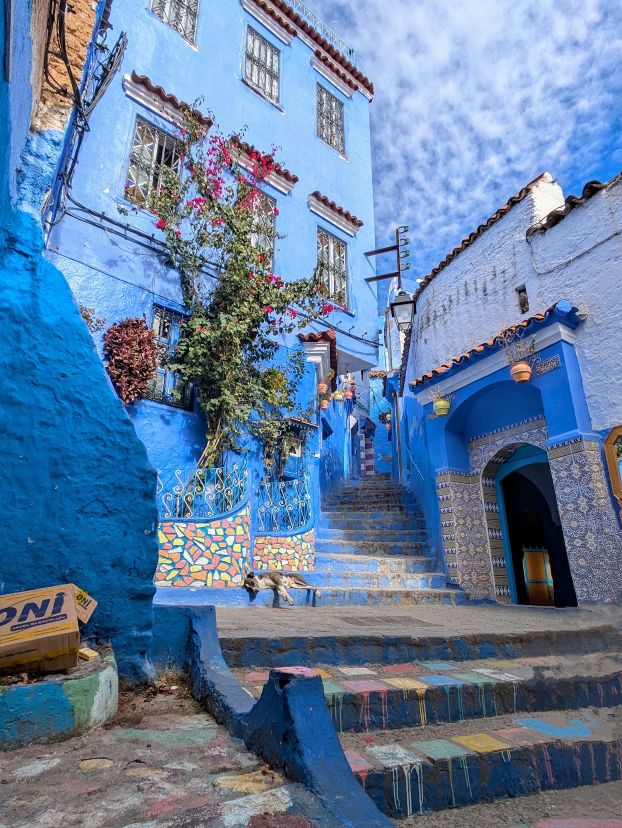
The blue repeated until it stopped feeling decorative. Color became structure — wrapping walls, steps, corners, and alleys into coherence. Movement slowed naturally. Walking replaced navigating. The city did not urge forward motion. It invited attention. Looking became sufficient.
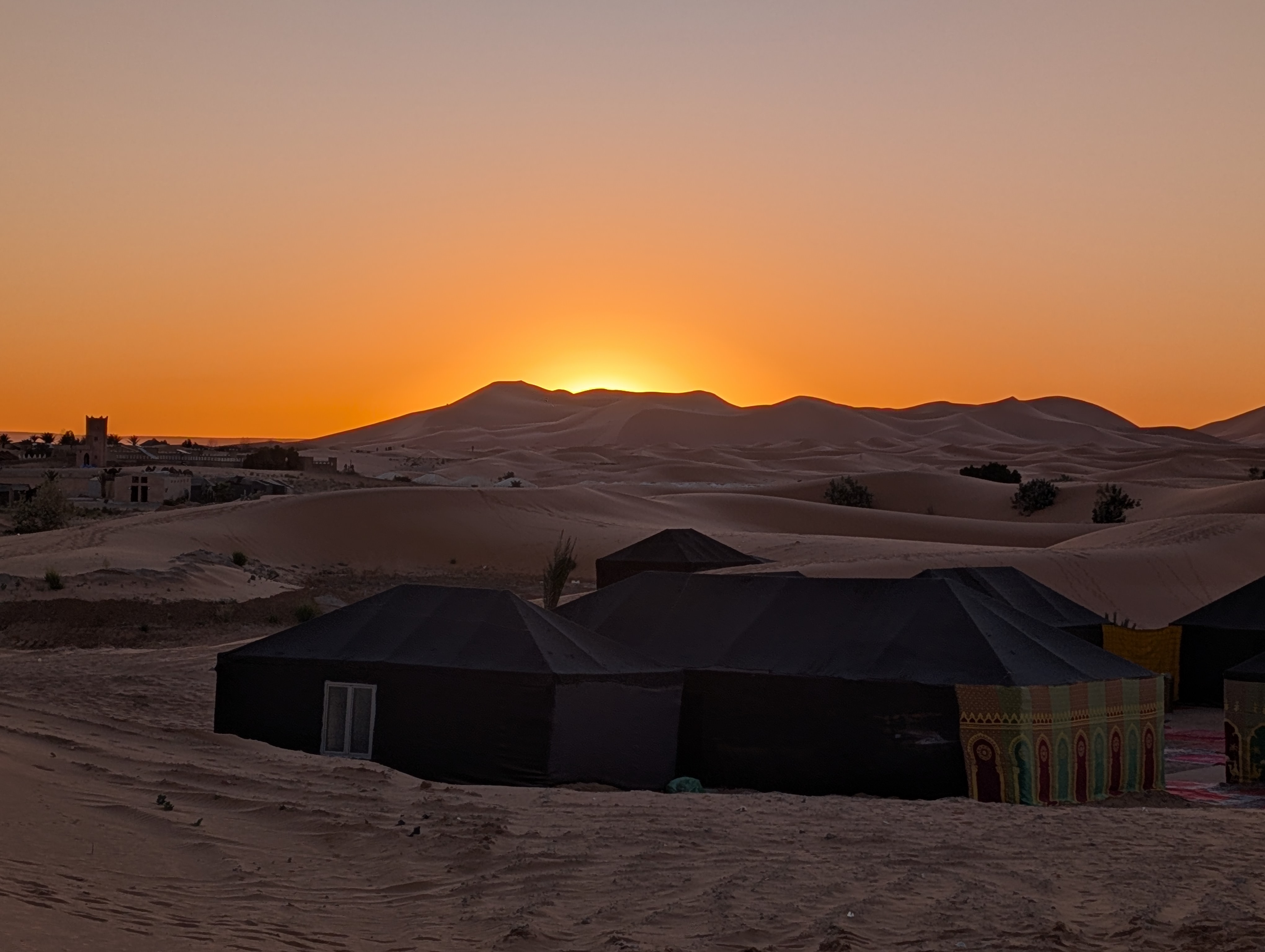
Beyond the hills, the land opened further and thinned without becoming barren. The desert arrived gradually — not as spectacle, but as absence. Travel adjusted its pace once more. Camels set the rhythm. Forward progress mattered less than continuity. Time lengthened. Sound loosened its grip.
Night in the desert did not perform. It held.
Silence persisted. Stars arrived without emphasis. Morning came without alteration. The experience was not about seeing more, but about remaining — long enough for scale to register without commentary.
Before another dawn, distance returned in a different form.
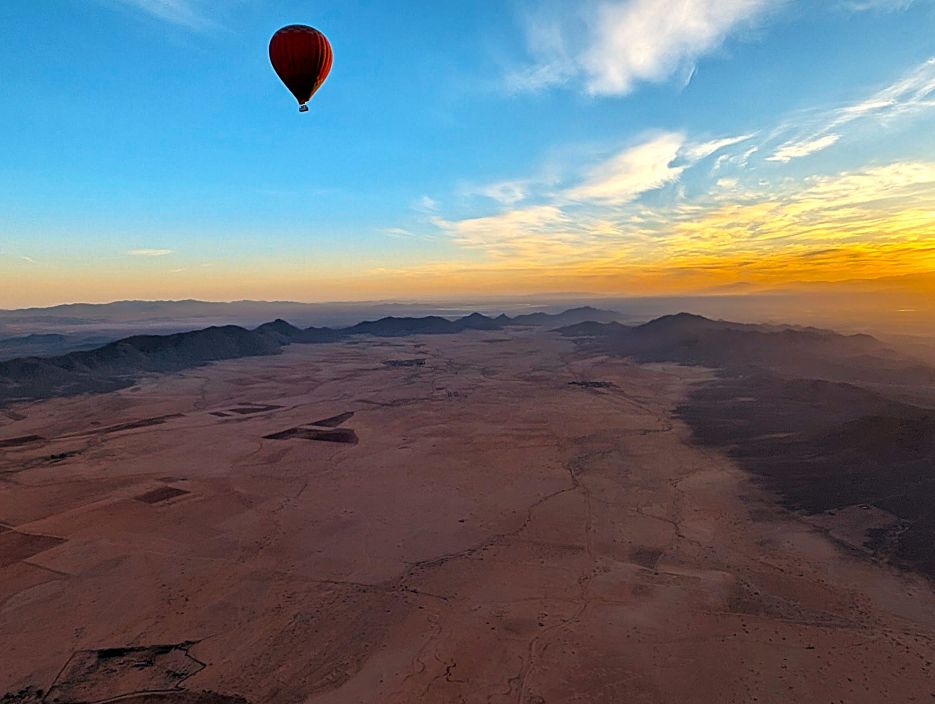
The balloon rose gently as light thinned the dark. From above, Morocco simplified itself. Fields resolved into quiet geometry. Roads curved with intention. Settlements appeared integrated rather than imposed. What had been walked, driven, and ridden compressed into pattern. The view offered no revelation — only confirmation.
Distance ordered what proximity had complicated.
Back on the ground, life resumed without acknowledgment. Markets opened. Roads filled. Work continued. The weather remained generous — cool mornings, clear days — allowing attention to persist without strain. Morocco did not overwhelm. It accumulated.
Understanding settled most clearly in the kitchen.
The cooking school stripped away abstraction. Food here was not presentation, but practice. Spices were handled, not romanticized. Techniques were demonstrated without explanation, then repeated until they made sense. Measurement followed experience, not precision.
Cooking collapsed the country into the hands.
Flavors carried geography. The conversations around preparation revealed rhythm rather than instruction. What architecture suggested, food confirmed: Morocco is sustained by what is done daily, carefully, and without display.
Participation revealed more than observation ever could.
By the end, no single image claimed authority. What remained instead was range — how Morocco moved between elevation and ground, silence and density, distance and intimacy, without losing coherence.
The country did not ask to be concluded. It allowed meaning to settle.
The Route (Context)
15 Days
Casablanca → Tangier → Chefchaouen → Rabat → Volubilis & Meknes → Fez → Erfoud → Sahara (Merzouga) → Aït Benhaddou → Marrakesh → Essaouira → Casablanca
The route mattered not because of the stops themselves, but because of how each transition changed the pace of the days.
The Itinerary (Reference)
Morocco at a Glance
-
Day 1: Arrive in Casablanca and settle in with a free afternoon.
-
Day 2: Visit Tangier and the blue-washed streets of Chefchaouen.
-
Day 3: Free day in Casablanca for exploration or relaxation.
-
Day 4: Explore Rabat, including Hassan Tower, Kasbah of the Udayas, and Andalusian Gardens.
-
Day 5: Tour Volubilis and Meknes, then continue to Fez.
-
Day 6: Discover the historic medina, tanneries, and cultural landmarks of Fez.
-
Day 7: Cross the Middle Atlas Mountains via Ifrane and Midelt to Erfoud.
-
Day 8: Visit Rissani and journey into the Sahara Desert for an overnight camp experience.
-
Day 9: Travel through Todra Gorge to Aït Benhaddou.
-
Day 10: Explore Aït Benhaddou and cross the High Atlas to Marrakesh.
-
Day 11: Tour Marrakesh highlights including Majorelle Gardens, Bahia Palace, and Djemaa el-Fna.
-
Day 12: Open day in Marrakesh with optional sunrise hot-air balloon ride.
-
Day 13: Take a Moroccan cooking class before heading to the coastal town of Essaouira.
-
Day 14: Enjoy Essaouira’s medina, fishing port, and evening Gnawa music.
-
Day 15: Return to Casablanca, including a visit to the Hassan II Mosque.
-,Day 16: Depart Morocco.
Day 1 · Arrival → to Rabat on Day 4
Arrive in Casablanca. The afternoon is unstructured — time to walk, orient, and adjust.
Day 2 · Tangier & Chefchaouen
Travel to Morocco’s northern edge, where Europe feels only an arm’s length away.
Begin in Tangier — whitewashed cliffs, sea light, and the blend of Spanish, Moroccan, and Mediterranean influences that always feels slightly unreal.
Continue inland to Chefchaouen, the Blue City, where everything slows: indigo steps, painted alleys, cats asleep in doorways. It’s an easy place to exhale and let the trip begin gently.
Blue City Pic
Overnight: back in Casablanca
Day 4 · Rabat
A guided exploration of Morocco’s capital: Royal Palace area, Bab Rouah, Hassan Tower, Kasbah of the Udayas, and Andalusian gardens.
Overnight: Rabat
Day 5 · Volubilis & Meknes → Fez
Travel inland to the Roman ruins of Volubilis, continue to Meknes to see Bab Mansour, and arrive in Fez.
Overnight: Fez
Day 6 · Fez
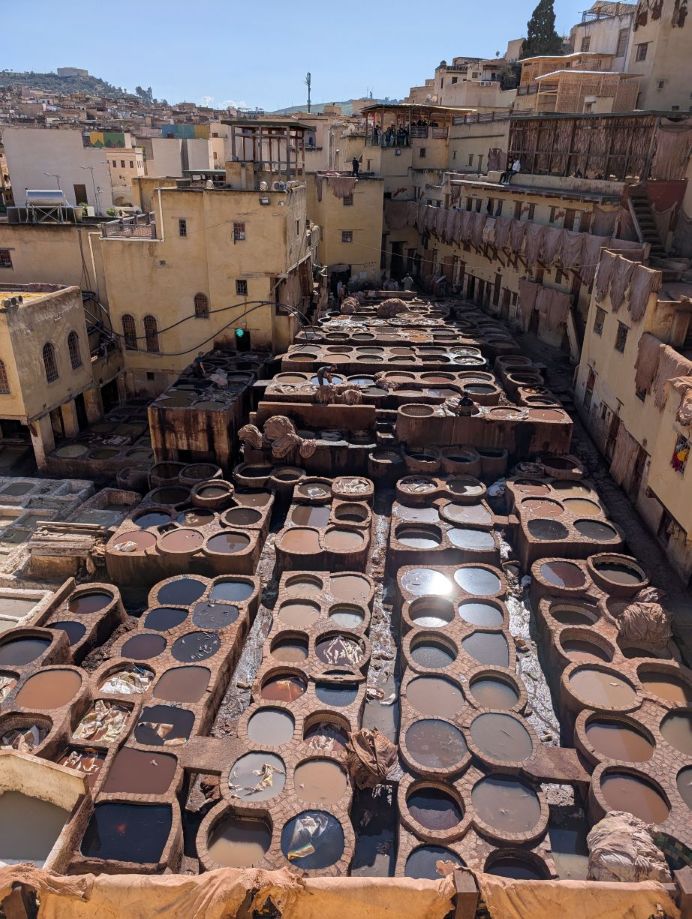
A full day in Fez’s medina — Bab Boujloud, workshops, madrassas, tanneries, and the mellah.
Tannery Pic
Overnight: Fez
Day 7 · Middle Atlas → Erfoud
Cross Ifrane and Midelt before descending into the desert landscape surrounding Erfoud.
Overnight: Erfoud
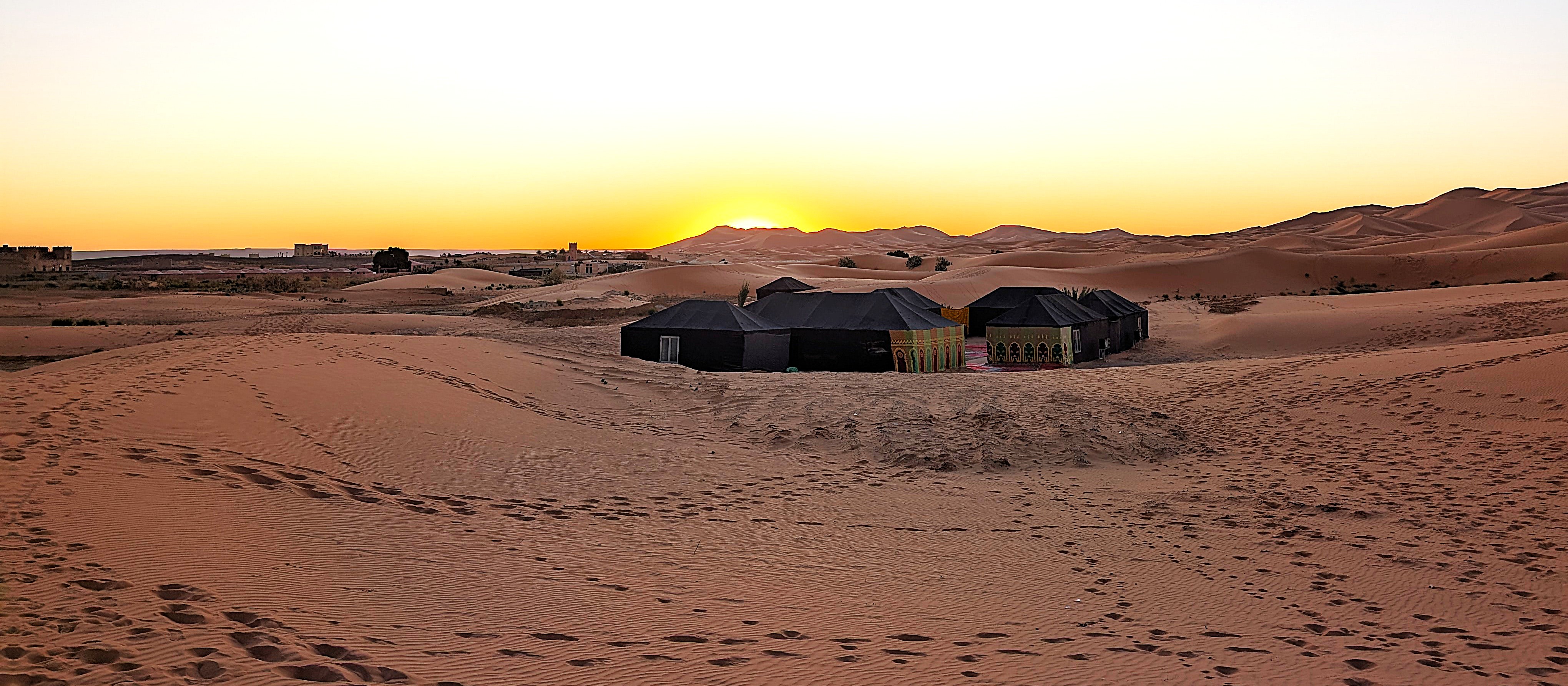
Day 8 · Rissani → Sahara Camp
Visit Rissani, meet locals in a Berber tent, and ride into the Sahara dunes.
Overnight: Sahara camp (Merzouga)
Day 9 · Todra Gorge → Aït Benhaddou
Drive through Todra Gorge, then continue west toward the fortified ksar of Aït Benhaddou.
Overnight: Aït Benhaddou / Ouarzazate region
Day 10 · Aït Benhaddou → Marrakesh
Explore the ksar, then cross the High Atlas into Marrakesh.
Overnight: Marrakesh
Day 11 · Marrakesh
Majorelle Gardens, Koutoubia, Bahia Palace, Saadian Tombs, and Djemaa el‑Fna.
Overnight: Marrakesh
Day 12 · Marrakesh (Open Day)
Optional sunrise hot‑air balloon flight (see link) or open exploration.
- Balloon Ride Overnight: Marrakesh
Day 13 · Marrakesh → Essaouira
Cooking class in a riad, then west to young coastal winds and open space.
Overnight: Essaouira
Day 14 · Essaouira
Medina, port, fish market, and Gnawa music in the evening.
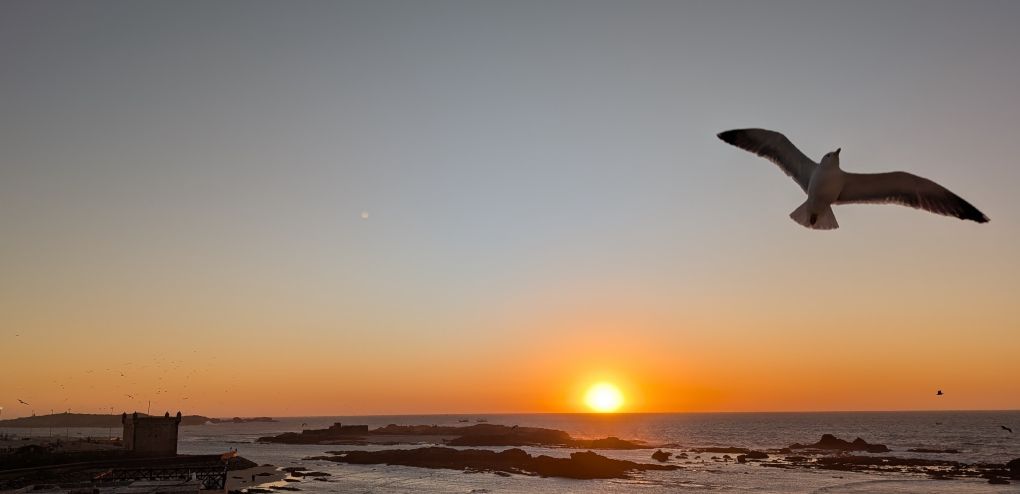
Overnight: Essaouira
Day 15 · Essaouira → Casablanca
Drive north to Casablanca with a city overview including the Hassan II Mosque.
Overnight: Casablanca
Day 16 · Departure
Transfer to the airport and depart Morocco.
Sunrise at the Camp Pic
Afterthoughts
This wasn’t a trip of highlights. It was a movement through registers — city, mountain, desert, kitchen, distance — and the way those registers shift how attention works. Morocco doesn’t unfold in a single direction. It recalibrates constantly.
On movement.
Morocco moves laterally. Roads across the Atlas widened understanding rather than advancing toward a goal. Camels reset time completely — pace became continuity, not progress. The desert overnight worked because it lasted long enough to stop feeling notable.
On distance.
The balloon simplified rather than explained. Fields became geometry. Settlements read as integrated rather than imposed. Distance ordered what proximity complicated, without claiming authority over it.
On color and restraint.
Chefchaouen worked by limiting itself. Blue wasn’t decoration — it was structure. Repetition slowed movement and rewarded looking over coverage.
On practice.
Meaning arrived most clearly in the kitchen. Cooking collapsed abstraction into the hands. Spices were handled, not narrated. Technique revealed geography more clearly than explanation.
On adaptation.
The argan tree stories mattered less as image than as correction. What once existed was adjusted. Morocco showed little interest in preserving a version of itself for display.
On pace (what worked).
Late winter softened everything — temperature, endurance, attention. Covering ground worked because it never competed aggressively. The desert night acted as a true exhale.
If we did it again.
Keep one night in the desert — exactly one. Anything more would dilute the quiet that makes it work.
Hold Chefchaouen as a full, unplanned day again, but pair it with a brief reach toward the Mediterranean to extend the contrast.
Let the cooking school run long; conversation matters as much as instruction.
Protect unscheduled mornings whenever possible.
What stayed.
Textures more than scenes: cooled air before dawn, blue pigment softening stone, spices staining fingertips, the steady realization that variation does not require disruption.
This wasn’t a trip about seeing Morocco.
It was a trip about learning how differently a place can move — without ever losing itself.
Field photographs from the Morocco journey:
View the photo archive
More Field Notes
See other movements across landscapes: