Spain-Interior
Spain doesn’t reveal itself through monuments alone.
It reveals itself through edges — cliff edges, city walls, river bends, coastlines, boundaries where cultures touched and reshaped one another.
A country carved by thresholds, transitions, and unexpected seams.
The Route (Context)
Madrid → Toledo → La Mancha → Cuenca → Valencia → Guadalest → Villajoyosa → Alicante → Cartagena → Granada → Córdoba → Aranjuez → Segovia → El Escorial → Ávila → Alcalá de Henares → Madrid
Spain as movement — across plateaus, along coastlines, through mountain passes, and into cities built on stone and story.
The Myth Thread — Spain and the Edges of the World
Every country carries a myth beneath its geography.
Egypt’s flowed in the Nile.
Morocco’s whispered in the mountains and dunes.
Spain’s is carved into edges — physical, cultural, and imagined.
This is a land shaped by thresholds.
Cliffs where houses cling like stubborn beliefs.
Plateaus that fall suddenly into plains.
Walls that wrap cities in vigilance.
Gates that once divided worlds.
Rivers that split territories and merge histories.
Coastlines where continents negotiate distance.
Spain did not inherit a single mythology; it evolved at the fault lines between them —
Iberian, Roman, Visigothic, Jewish, Moorish, Christian —
stories layered like sediment, like glaze, like the ceramics you’ll later hold in Valencia.
Every new culture pressed itself into the last, not erasing but reshaping,
leaving a nation that reads like palimpsest stone.
And in this landscape of edges, craft became its own kind of myth.
Blades forged in Toledo with a discipline that could outlive empires.
Ceramics fired in Valencian kilns, color remembering fire long after the flame died.
Architecture that bends light, echoes prayer, or holds the silence of kings.
Traveling through Spain means crossing these thresholds again and again —
from rain‑soaked fortress to cliff‑born village,
from quiet forge to futuristic arc,
from walled city to open plain.
It is a journey through a land that has always lived at the meeting points —
between cultures, between eras, between earth and sky.
A country defined not by borders, but by the moment things change shape.
This is the myth running beneath the days that follow —
Spain as a nation of edges,
and your route as a passage across them.
The Itinerary (Reference)
Spain at a Glance
-
Day 1: Arrival, Toledo, Alcázar & Swordmaking Heritage
-
Day 2: La Mancha Windmills, Cuenca & Valencia
-
Day 3: Valencia’s Historic Center, Ceramics Museum & City of Arts and Sciences
-
Day 4: Guadalest, Villajoyosa, Alicante, Barrancos de Gebas, Guadix & Granada
-
Day 5: Granada’s Monasteries, Basilica & Alhambra Sunset View
-
Day 6: Alhambra, Nasrid Palaces & Generalife Gardens
-
Day 7: Granada to Córdoba, Jewish Quarter, Roman Bridge & Royal Stables
-
Day 8: Aranjuez Royal Palace & Gardens to La Finca
-
Day 9: La Granja, Segovia Aqueduct, Alcázar & El Escorial
-
Day 10: Alcalá de Henares, Madrid Highlights & Departure
Toledo Pic
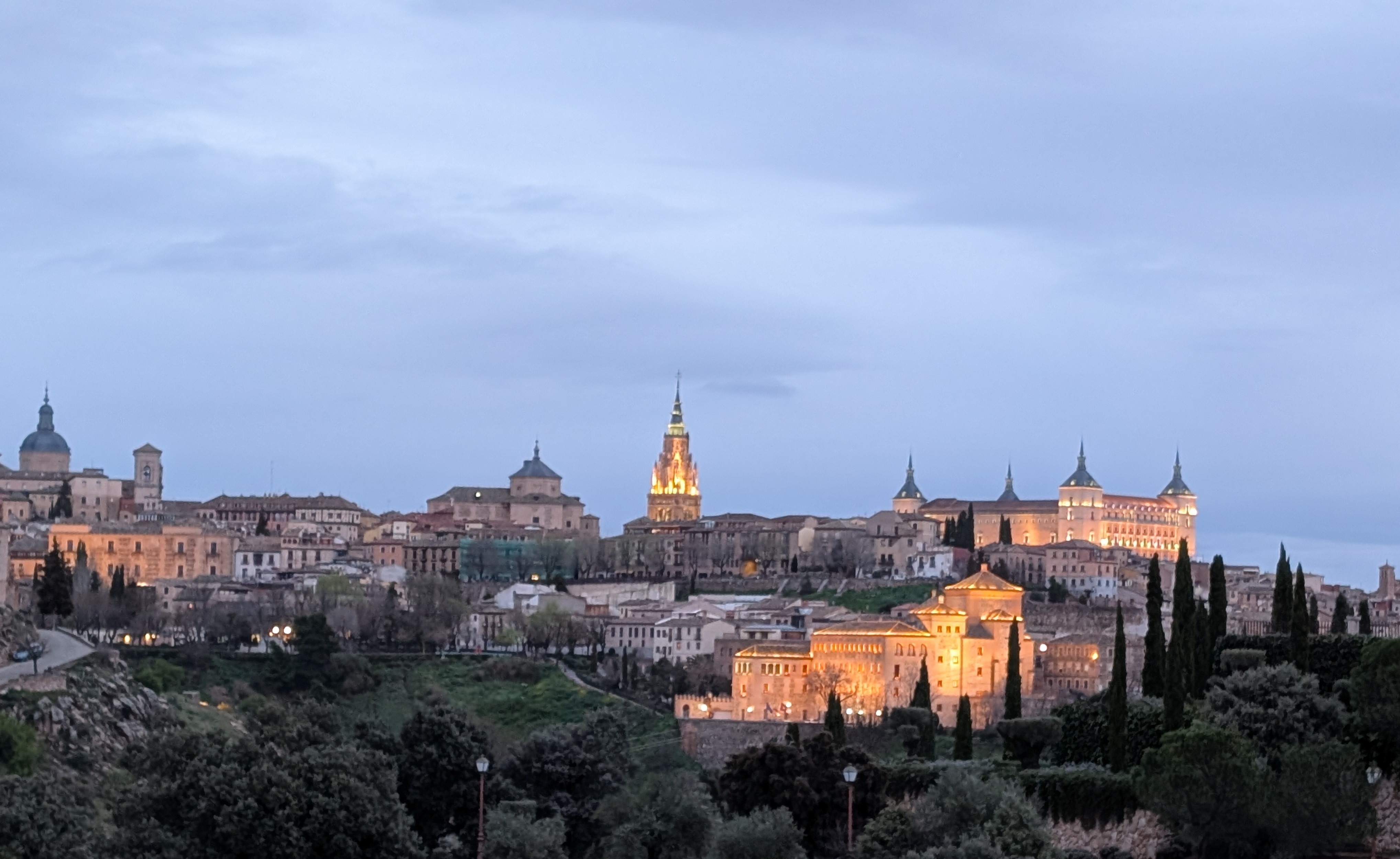
Day 1 · Arrival → Toledo
Where the river bends like a blade.
Spain begins beneath a low, clouded sky — the kind that softens the edges of the world and turns the drive from Madrid into a long ribbon of grey.
A fine drizzle drifts across the plateau. The horizon exhales.
Toledo rises ahead not in brilliance but in shape — a dark stone silhouette emerging from mist, held aloft by the looping embrace of the Tagus. You pass under Bisagra Gate, its rain‑darkened stones gleaming like newly tempered metal.
The old streets tighten and ascend, carrying you upward to the Alcázar of Toledo — a fortress sharpened by centuries, now blurred by weather. Inside, the Army Museum holds its breath: armor dulled to pewter by time, banners sagging with remembered wind, maps cross‑hatched with ambition and retreat.
Nothing here demands attention.
Everything waits.
Down the slope, heat gathers in the dim glow of Fábrica Zamorano.
Sparks rise like brief constellations.
A blade glows, ember‑bright, as the sword‑maker folds steel with steady, deliberate grace — the old Toledo craft alive in his hands.
Sometimes, though, the forge sleeps.
You may not see the fire, only its echoes — the quiet furnace at rest in the back, its coals cooling between heartbeats.
The real heat is in the motion: copper coaxed into a knife’s spine, metal shaped without flame, memory guiding technique.
In a city built on edges, even the fire chooses silence when the craft does not.
By late afternoon, the drizzle becomes a soft mist.
San Martín Bridge blurs at the edges; San Juan de los Reyes stands half‑absorbed into the sky.
Notice the river as it cuts thru the rock face around the city. The bridge allows passage.
Bridge Pic
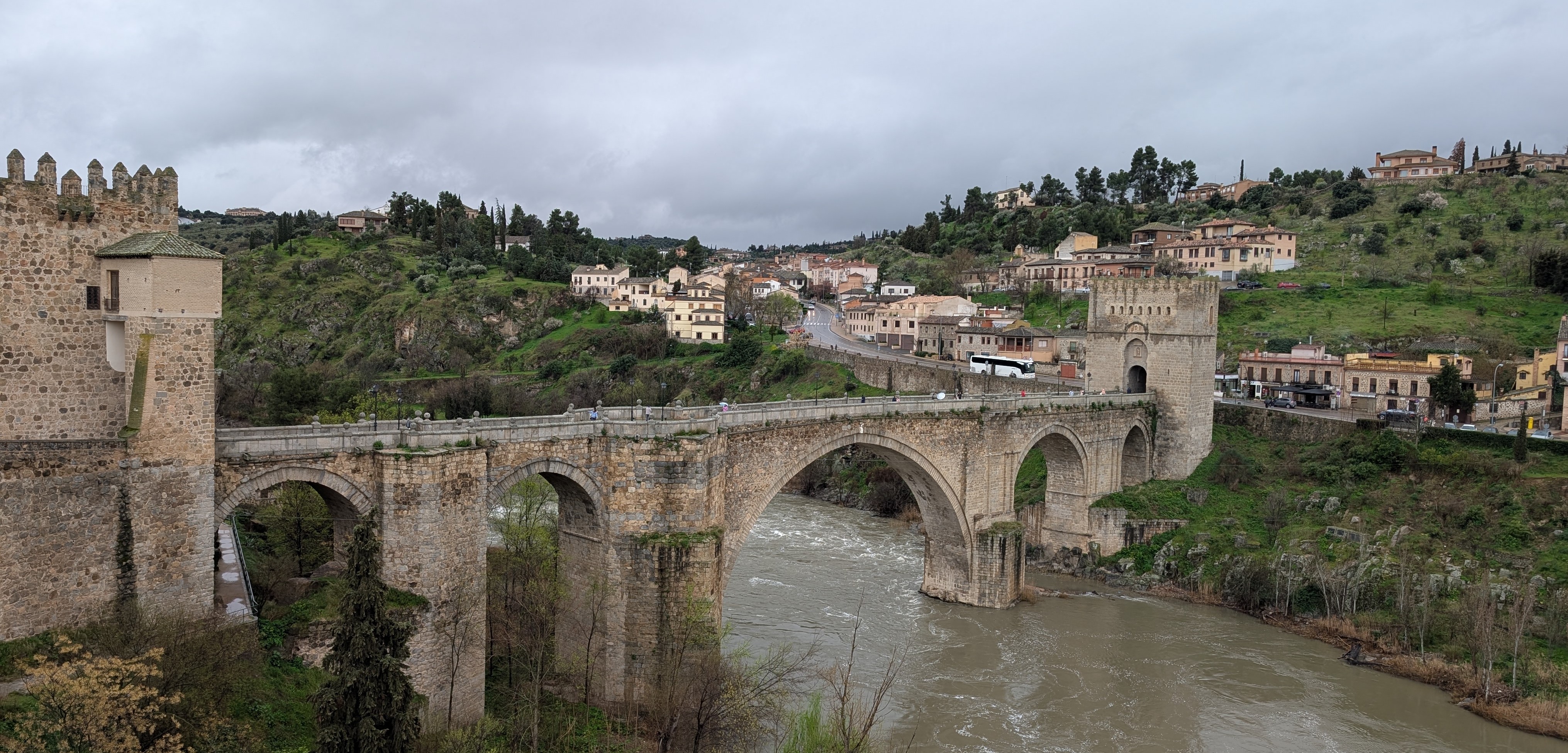
From Mirador del Valle, Toledo dissolves into a watercolor — outlines softened, history rendered in cool tonal hush.
You end the day as these grey evenings ask you to:
indoors, warm, unhurried — a bottle of regional Castilian wine breathing open after the long road.
The kind of wine made for stone cities and cold nights.
A quiet pause, a soft landing, a slow beginning.
Overnight: Toledo
Day 2 · Windmills → Cuenca → Valencia
Where imagination leans into the wind—even when the giants sleep.
Morning opens in a muted palette — low clouds stretched thin across La Mancha, the chill lingering from the night before.
The drizzle has quieted, but the air is heavy with the sense that rain hasn’t made up its mind.
The plains widen.
Long sweeps of earth, sparse and wind‑brushed, the kind of landscape that invites stories.
Then the windmills appear.
Windmills Pic
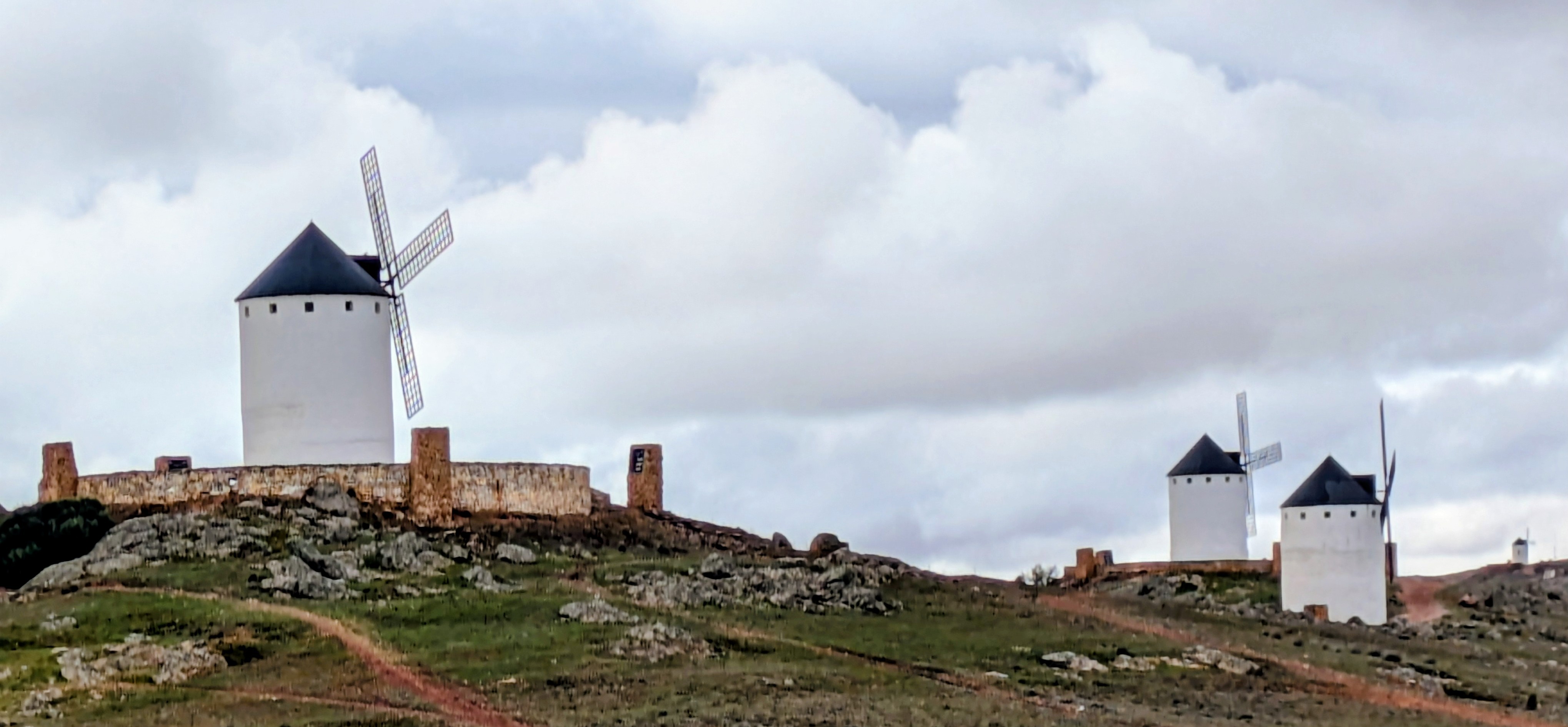
White towers rising from the ridge, their great wooden arms held still —
sails furled, machinery resting, the giants asleep.
Yet the stillness doesn’t diminish them; it transforms them.
You realize the myth never required motion.
Even motionless, these windmills tilt the mind toward something larger, a reminder that imagination is a kind of wind all its own.
The road curves into the mountains, and Cuenca emerges — not built, but clinging.
Hanging Houses Pic
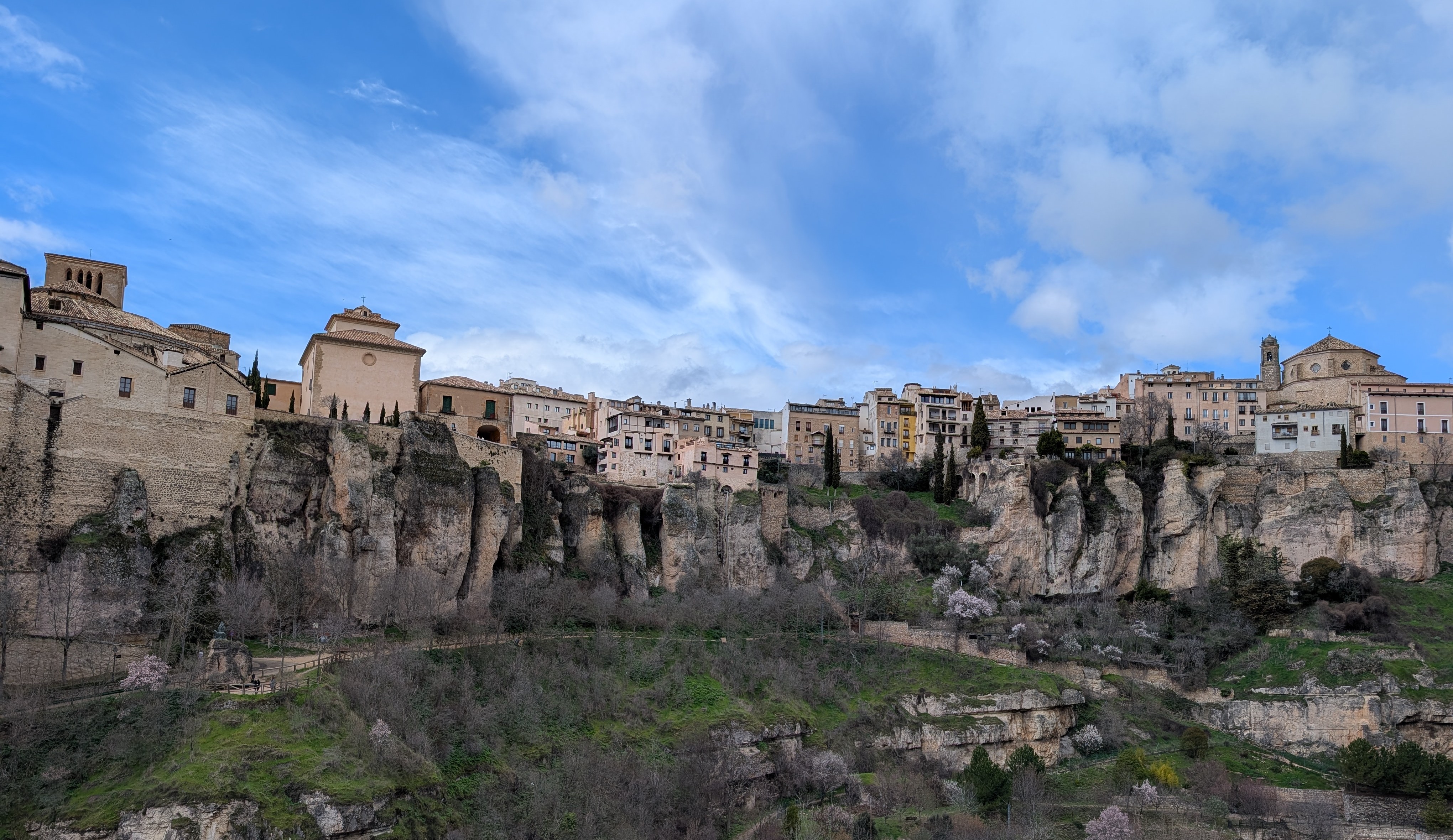
The hanging houses grip the cliffs like stubborn memories refusing to fall.
Below, the gorge exhales a cool breath that carries the dampness of the day.
From Puente de San Pablo, the whole city hovers between stone and sky, its edges softened by the clouded light.
By late afternoon, the landscape shifts again.
The plateau gives way to hints of coastline, and the air carries a faint trace of salt.
Valencia approaches in widening streets and brighter facades, though the day remains wrapped in grey.
Still, the city feels like promise —
a place preparing to shimmer when the weather finally breaks.
Overnight: Valencia
Day 3 · Valencia
Where the city waits beneath a sky holding its breath.
Valencia wakes under a thick grey ceiling — clouds drifting low, stitched with the cold promise of rain.
The air feels paused. Sound carries differently in this weather: softened, compressed, as if the city is speaking in a lower register.
In Plaza del Ayuntamiento, the fountains murmur but the usual warmth is missing.
The stone façades wear a damp, muted sheen.
People move briskly; coats pulled close; conversation held tight against the chill.
The weather suits the city — it reveals its lines without distraction.
A few streets away, you turn toward something more baroque than the weather allows:
the Palacio del Marqués de Dos Aguas, home of the National Ceramics Museum.
Its alabaster façade rises like a theatrical gesture carved from cloudlight —
rivers suspended in stone, the Virgin poised above the doorway,
a palace that feels conjured rather than constructed.
Inside, rooms unfold in shimmering textures.
Rococo salons, frescoed ceilings, mirrors that multiply the dim daylight.
The ceramics — Christian, Mudéjar, medieval pieces, Valencian glazes, even Picasso’s clean-lined experiments —
don’t sit behind glass so much as hum beneath it.
Clay remembering hands.
Color remembering fire.
A museum, yes — but also an archive of touch.
Back outside, the grey still holds.
In Plaza de la Reina and Plaza de la Virgen, the cathedral tower leans inward beneath the heavy sky.
Pigeons huddle. Bells ring muted.
You wander into Turia Park, the old riverbed turned quiet corridor.
Today it feels contemplative — no children running,
no cyclists carving patterns under the bridges.
Just the hush of damp pathways and the metallic scent of weather waiting to break.
The City of Arts and Sciences rises in pale, bone‑white curves,
structures that seem half terrestrial, half dream —
even the future feels subdued beneath the storm‑colored vault.
City of Arts & Science Pic
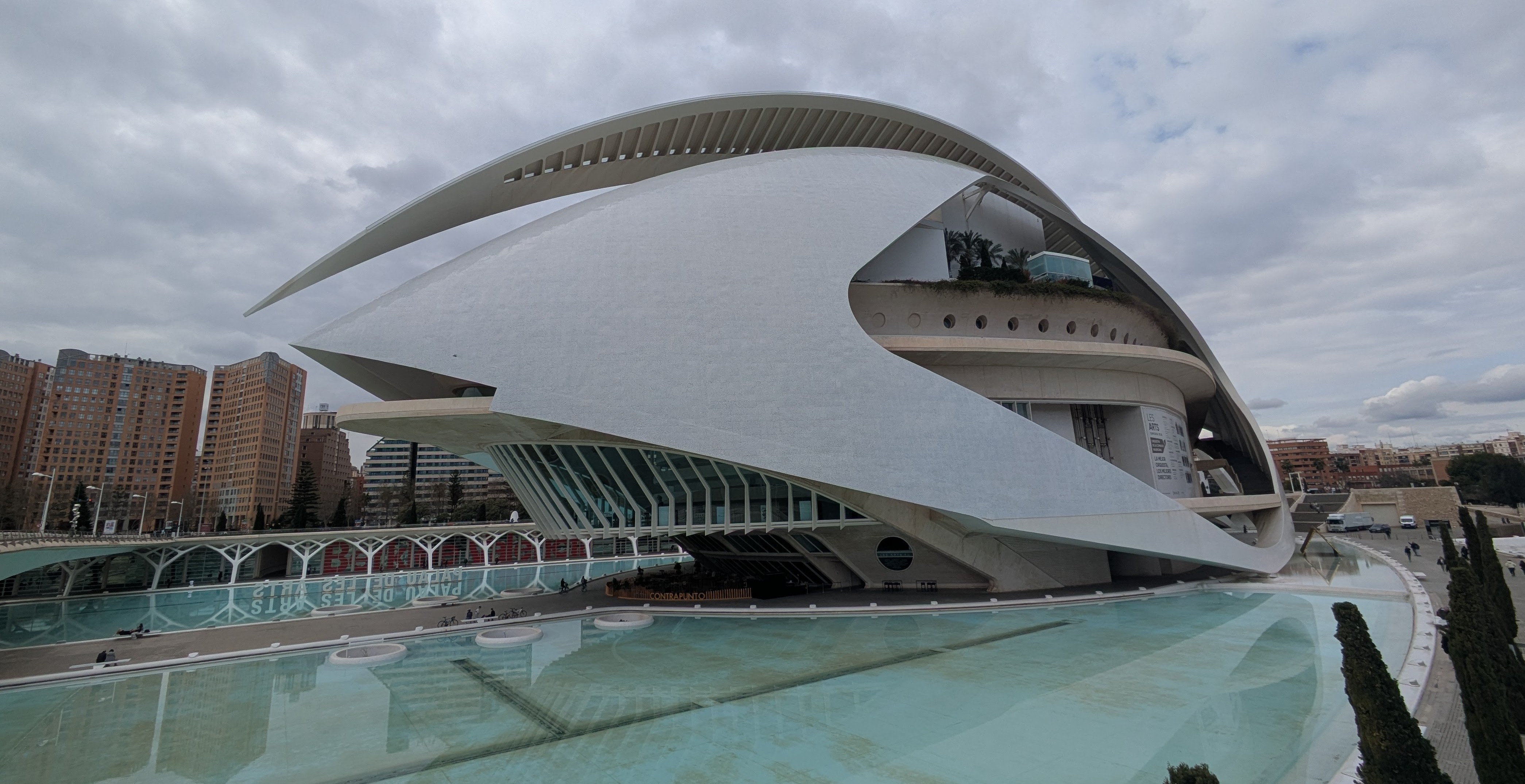
Evening gathers at the Torres de Serranos,
stones darkening as clouds thicken.
Dinner brings warmth back into the day.
At Nederland 1814, you order seafood tapas that feel like the coastline distilled into three plates:
cuttlefish, soft and smoky;
octopus, tender with just enough char;
and a cold salpicón‑style mix of seafood — bright, clean, balanced.
The best meal of the trip so far.
Simple. Confident. A dialogue between salt and fire.
Then, as if the city wanted to answer the day’s cold restraint,
fireworks crack open the night near the waterfront — sudden color against a sky that had held itself all day.
Blues, whites, golds — brief flowers of light blooming over the rooftops.
It feels like the perfect contradiction:
a grey day ending in sparks.
Overnight: Valencia
Day 4 · Guadalest → Villajoyosa → Alicante → Barrancos de Gebas → Guadix → Granada
Where the coastline shines, the earth changes color, and the mountains remember winter.
Morning opens in an unexpected clarity —
the grey finally retreating as you leave Valencia for the hills.
By the time the road rises toward Guadalest, the sun is fully awake,
spilling warm gold across the cliffs and rooftops.
The fortress stands bright above its turquoise reservoir,
a village suspended between altitude and light.
Guadalest Pic
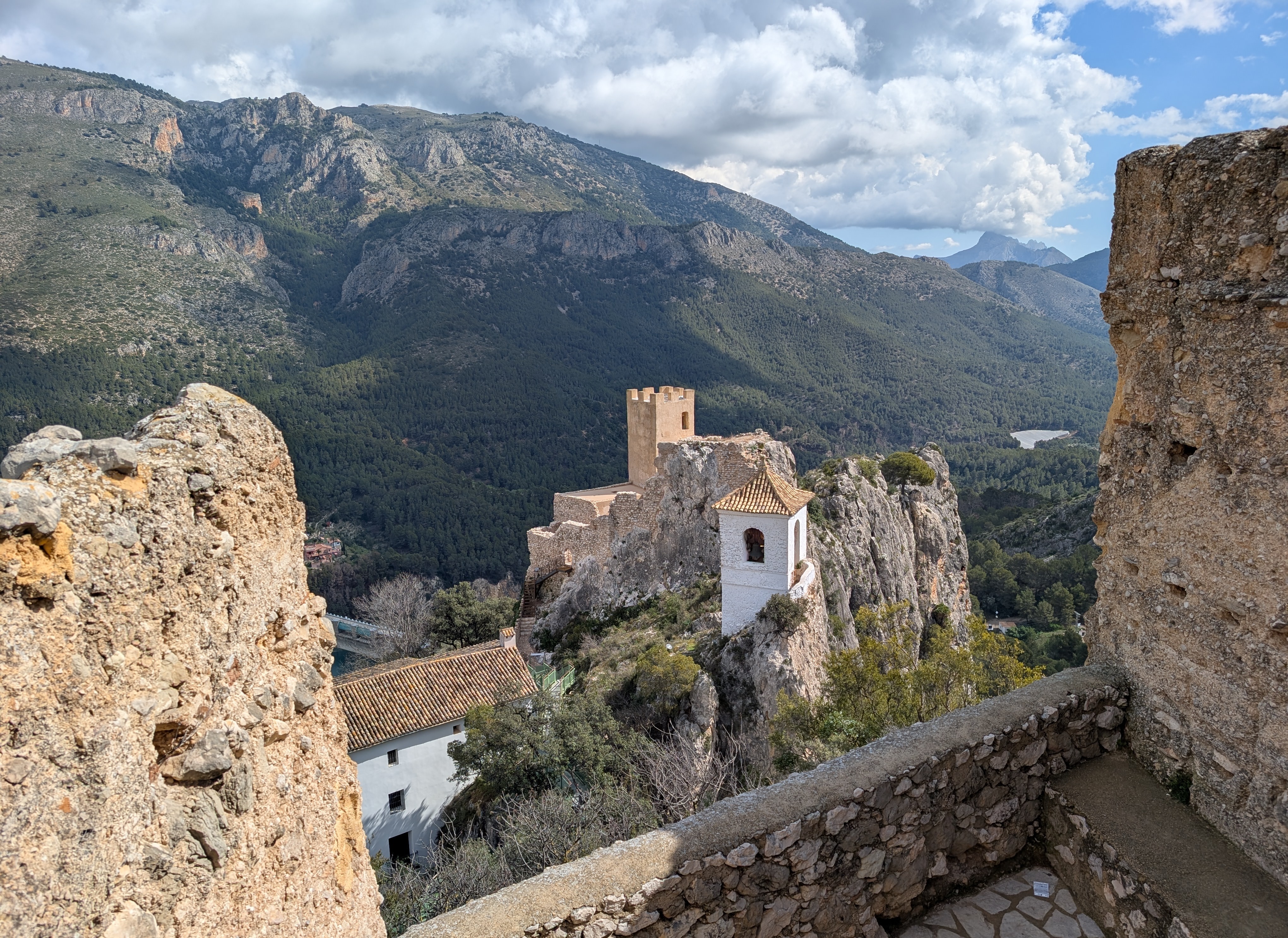
Descending toward the coast, the day widens further.
In Villajoyosa, the sea glitters in restless blue,
and the painted facades — coral, ochre, cobalt —
flare brilliantly beneath the clean sky.
Nothing in the weather hints at what the afternoon will eventually become.
Alicante arrives in full sun.
Santa Bárbara’s castle stands crisp against the light.
hanging on the cliffside.
The esplanade palms cast long, sharp shadows
as the city leans comfortably into its brightness.
A good moment.
A brief, unhurried stretch of the day.
Then the road turns inland —
and Spain changes shape again.
You stop at Mirador Barrancos de Gebas,
a landscape that feels almost lunar.
Pale, eroded hills fold and ripple like frozen waves,
a badlands carved by time and silence.
The rain, drizzling now,
revealing a land sculpted in beige, blue, and bone.
A quiet, otherworldly pause.
Barrancos Pic
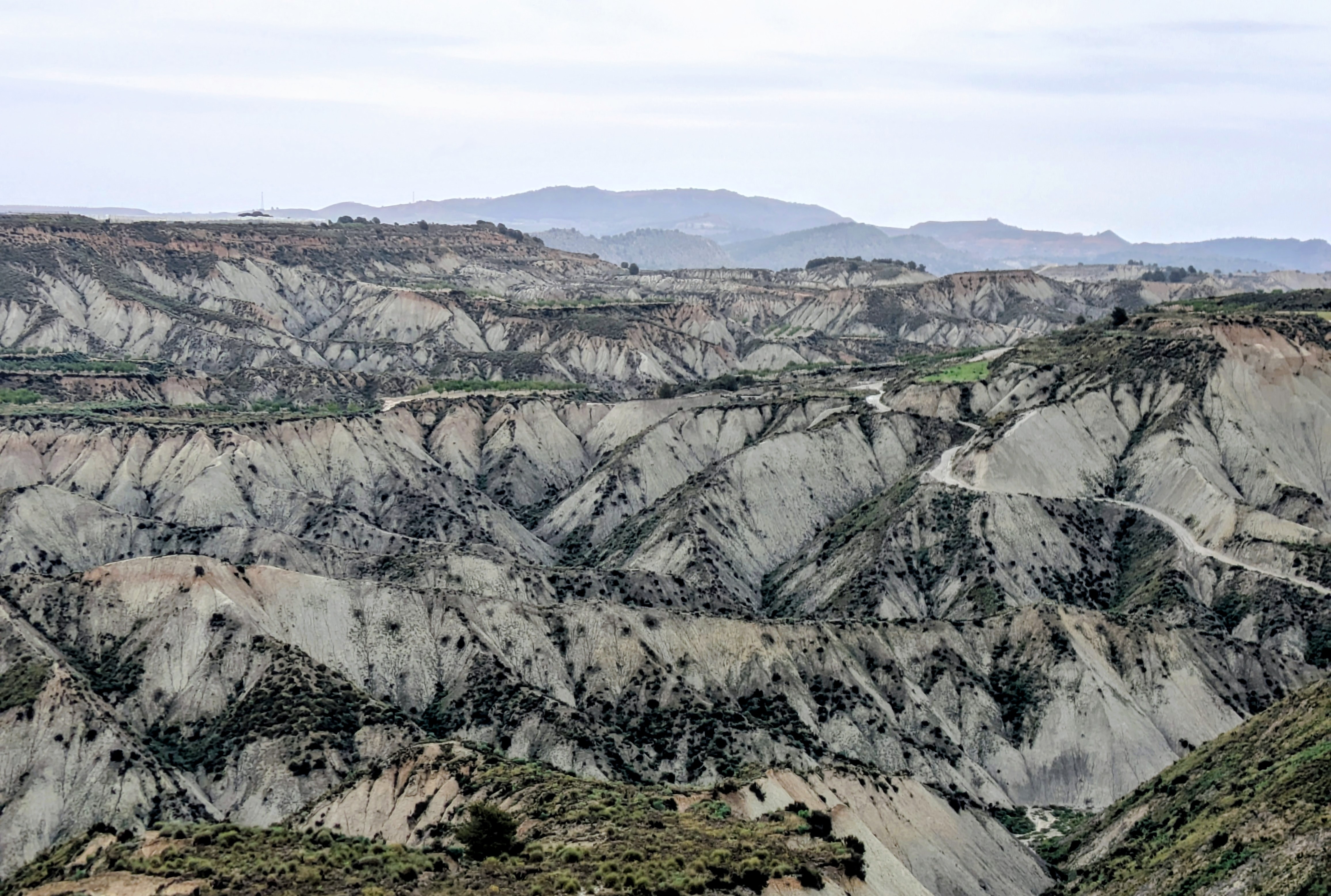
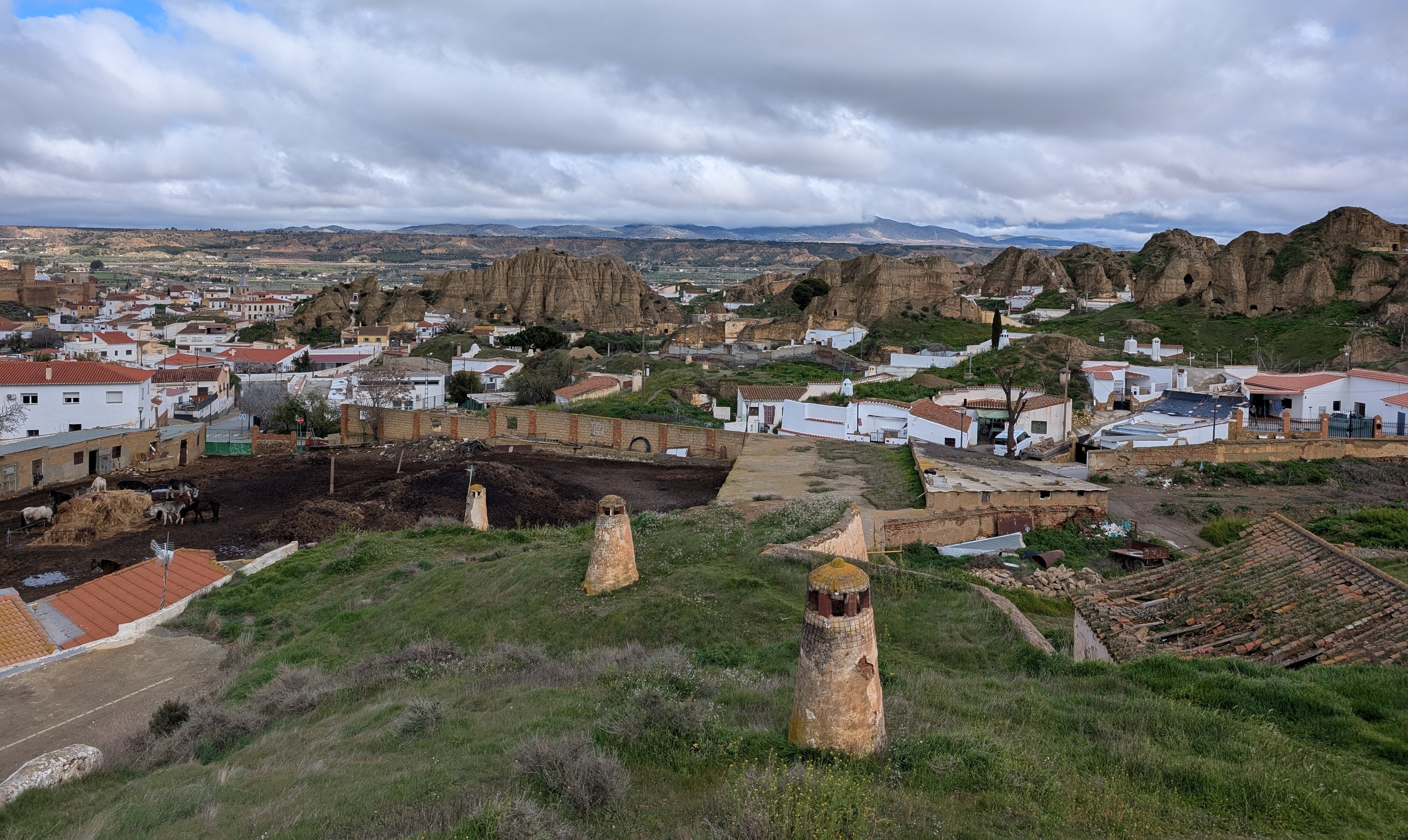
Further on, Guadix rises where earth becomes architecture —
a town of cave dwellings dug into soft hillsides,
white chimneys poking from mounds of earth like markers of hidden homes.
It feels half ancient, half unreal,
a settlement shaped not by walls but by the land itself.
Guadix Pic
After Guadix, the altitude begins to climb.
The warmth drains from the air.
Clouds gather over the Sierra Nevada in slow, heavy strokes.
The sky darkens at the edges,
and then — without force, without urgency —
snow.
Light flakes drift across the windshield,
melting on contact,
a soft reminder that winter still lingers in the mountains
even when the coast pretends otherwise.
The road becomes a long, quiet passage through weather in transition.
Granada appears late in the afternoon, still bathed in daylight,
the last of the sun catching on the rooftops and hills.
No storm here yet — just a cool, late‑afternoon calm
as the city settles into its own rhythm.
A day that began in bright coastal color
and ended in a mountain snowfall —
Spain revealing how quickly the world can change its light.
Overnight: Granada
Day 5 · Granada
Where devotion becomes architecture and sunset crowns the city.
Granada wakes in cool morning light —
the storm behind you, the mountains still carrying a memory of snow.
The city feels unhurried, textured, ancient in the way only hill cities can be.
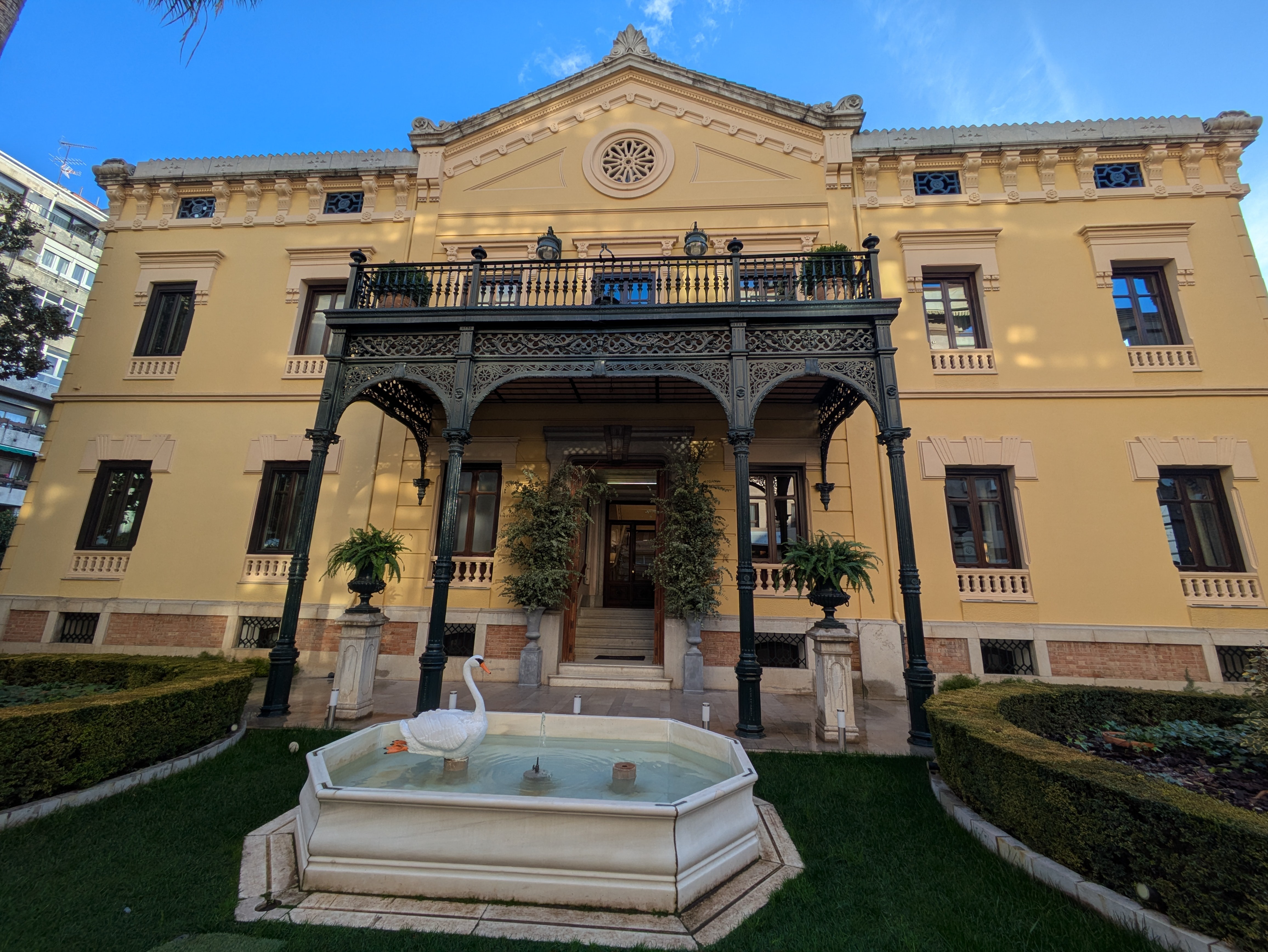
You step out from Hospes Palacio de los Patos,
letting the day gather you into its narrow streets and bright white facades.
Hotel Pic
Your first stop is the Real Monasterio de San Jerónimo,
a place where stone seems to inhale the morning.
The cloister arches frame quiet gardens,
and the gold-laced altarpiece burns with its own internal dawn.
The upstairs choir is closed —
a rope, a silence, a reminder that some spaces
remain beyond reach.
But the monastery still feels alive,
its walls carrying that low, devotional hum
that monasteries master better than any choir.
From there you walk deeper into Granada,
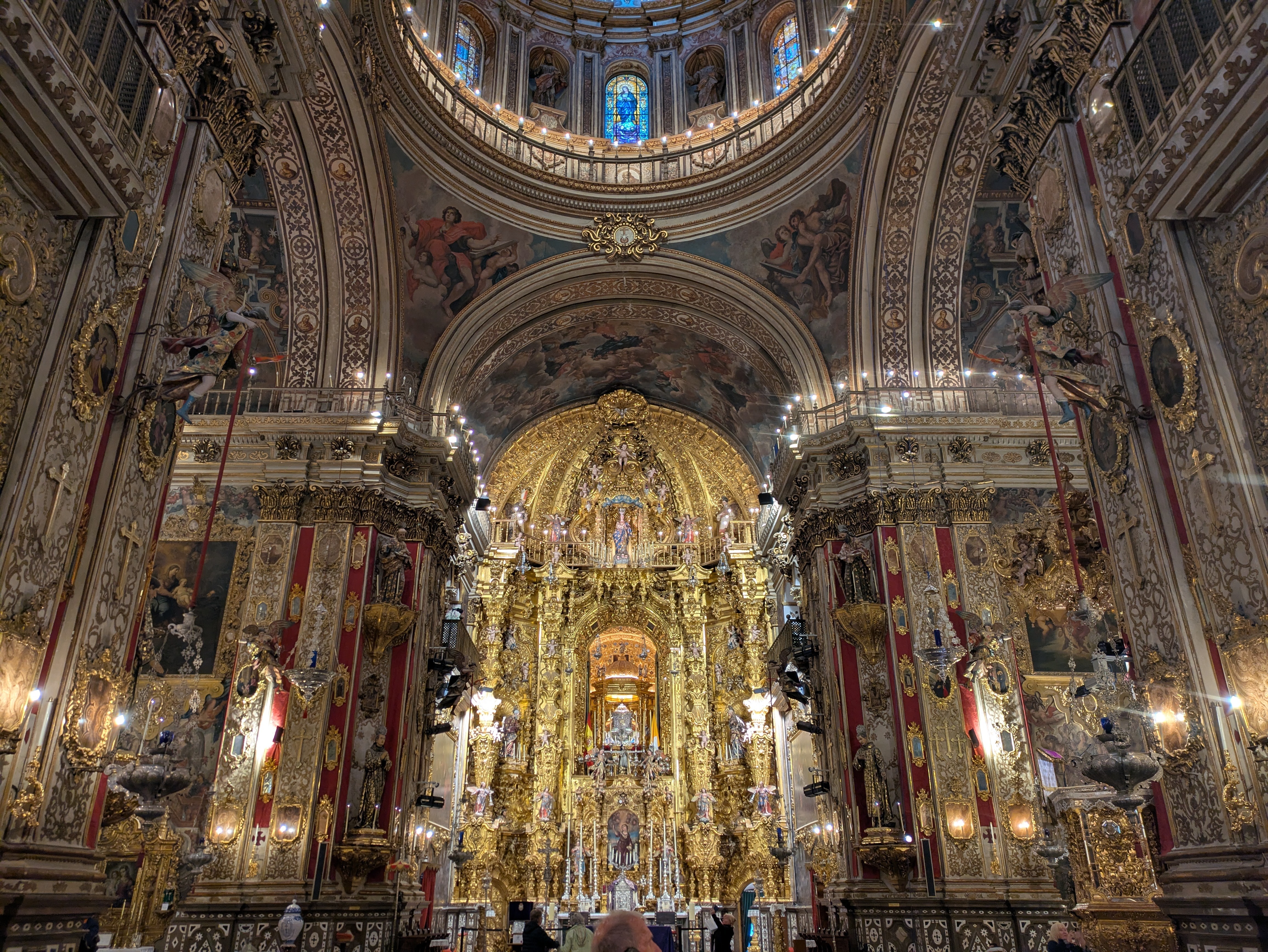
toward the Basílica de San Juan de Dios —
a baroque explosion of gold, mirrors, and soaring devotion.
With the audio guide, the space folds open slowly:
stories of relics, saints, craftsmen, and centuries.
Gold that once seemed overwhelming
starts to feel like geology —
like a vein of faith that erupted upward into a building.
Every surface is intent.
Every detail is testimony.
Basilica Pic
Afternoon softens the city.
You wander through alleys that tangle and lift,
past tea houses, old walls,
and pockets of light that shift as clouds drift over the Sierra Nevada.
As the day leans toward evening,
you climb toward the Mirador de San Nicolás,
Granada’s most iconic overlook.
The ascent is steady,
the stones underfoot warm from the day.
And then —
the view.
Alhambra Pic
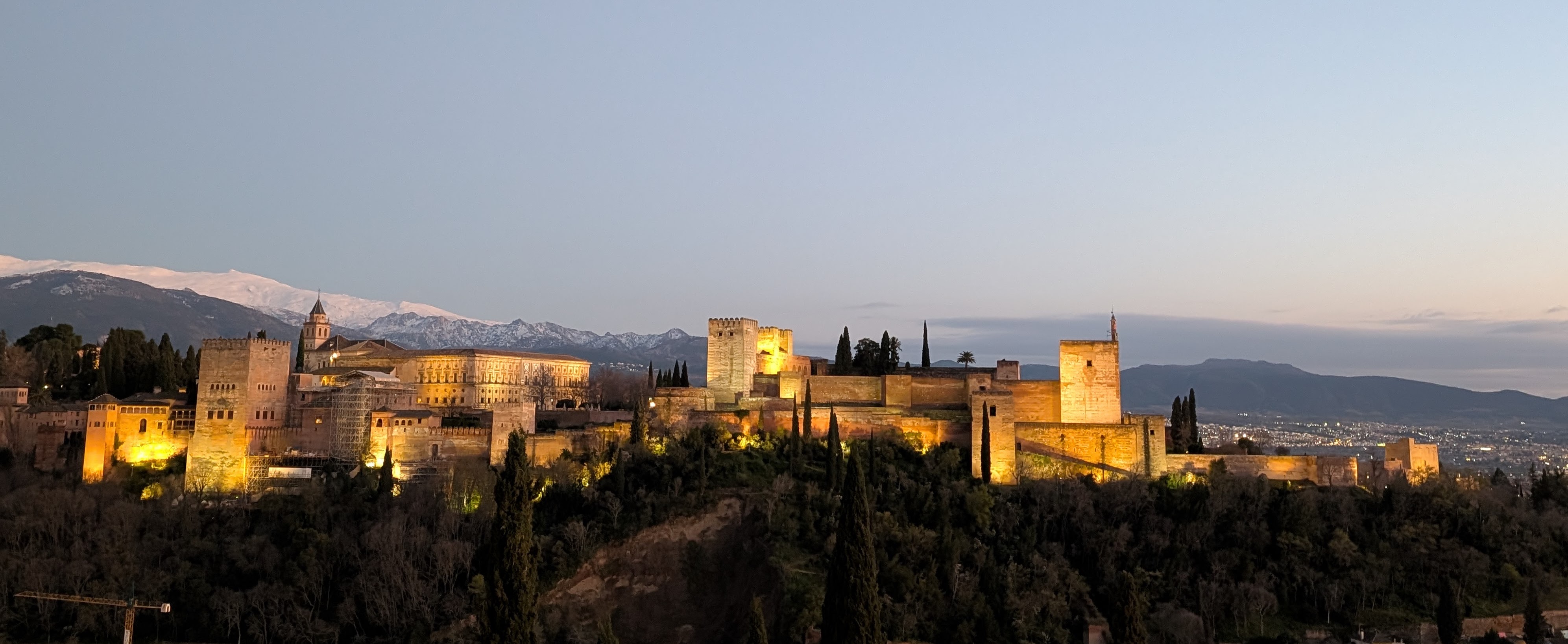
The Alhambra stands across the valley,
burnt orange in the sinking sun,
the fortress glowing as if lit from within.
Behind it, the mountains gather shadows like folded cloth.
People cluster quietly,
cameras ready, conversations soft,
everyone waiting for the same moment:
the line where light meets stone and makes it gold.
You stay until the last color drains from the sky.
Until the palace becomes silhouette.
Until the city lights rise like small constellations.
Granada settles into night,
and so do you —
a city of devotion, gold, and sunset
preparing you for the palace it guards.
Overnight: Granada
Day 6 · Alhambra (9:00 AM)
Where the palace demands an approach, not just an arrival.
Granada wakes in full daylight —
the storm long gone, the air cool but bright,
the mountains still retaining snow you saw on the drive.
You leave Hospes Palacio de los Patos early,
walking through quiet streets that still feel touched by yesterday’s clarity.
You follow the river that curls beneath the Alhambra’s eastern slopes,
water slipping over stone, sunlight warming the path.
It feels like the perfect, gentle approach —
until it isn’t.
At the back entrance, the gate is closed.
Runoff from the previous day’s flooding has washed out the route,
mud and debris cutting off what should have been
the easy way in.
You check the time —
the 9:00 AM tour is waiting.
You have minutes, not margins.
So you climb.
A steep cut in the hillside becomes your unplanned path —
dirt, loose rock, uneven footholds,
the kind of ascent that demands lungs and legs
you did not expect to give this morning.
You move quickly,
panting, sweating,
your wife pushing herself beside you,
the climb becoming a mixture of urgency and determination.
The sky opens above the trees,
blue widening as you gain height.
The city drops away behind you.
And then —
you break out onto Vista Panorámica Silla del Moro.
Vista Pic
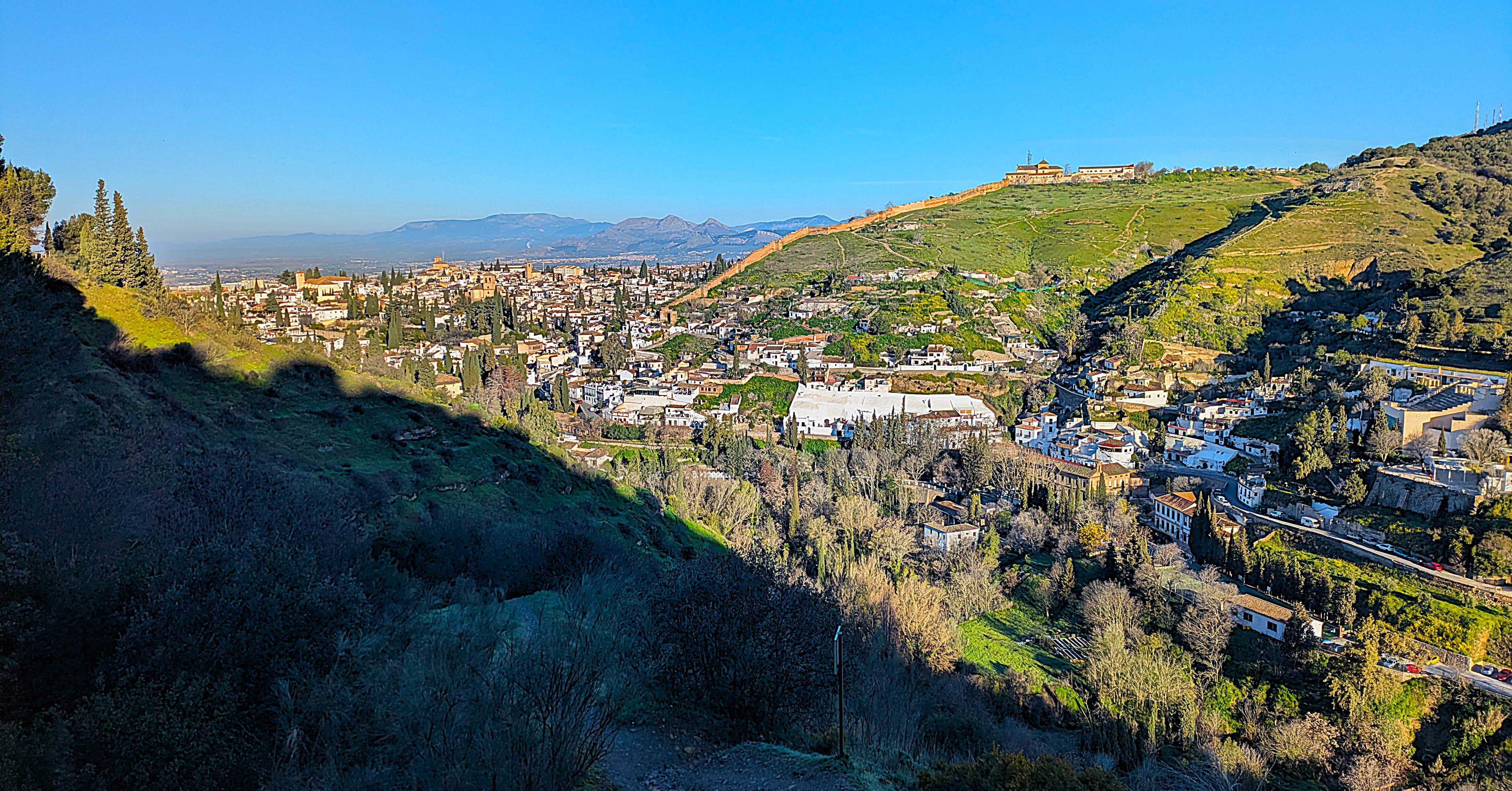
An accidental summit.
A vantage you couldn’t have planned.
The Alhambra below you in full morning light —
towers, courtyards, and carved walls arranged like a dream set out to dry on a hillside.
Breathless, sweating, exhausted —
you stand there stunned by the view you didn’t know you were climbing toward.
It feels less like missing the entrance
and more like the palace insisting you enter
on its terms.
You descend quickly,
legs still shaking,
and reach the meeting point just in time —
heart still racing as the tour begins.
Inside the Nasrid Palaces,
the morning grows quieter.
Geometry replaces motion.
Light pools in courtyards like a second sky.
Water murmurs in stone channels,
carrying centuries of intention.
Nasrid Palaces Pic
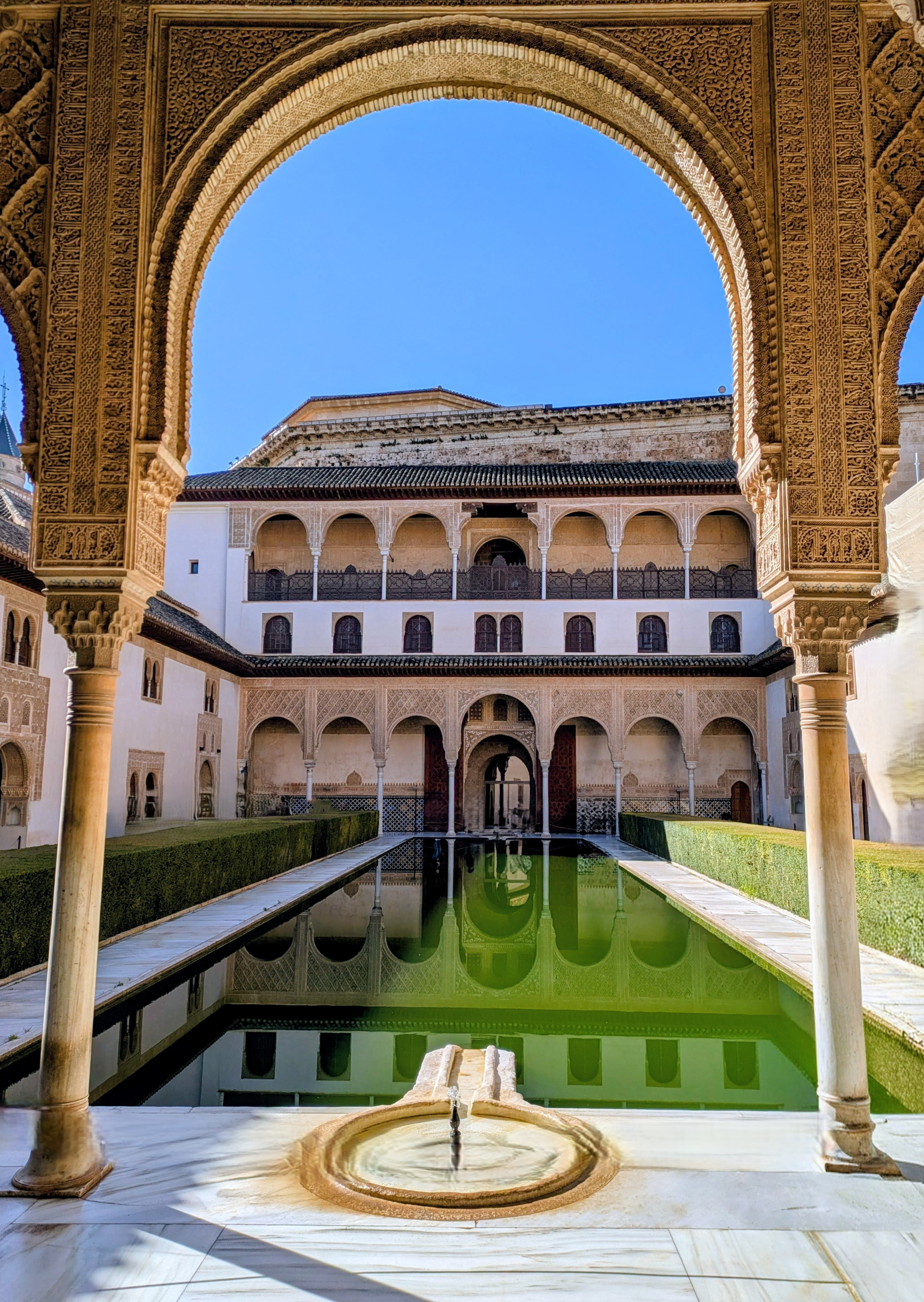
In the Patio de los Arrayanes,
the long pool holds the palace upside down,
as if the reflection were the truer version.
Stucco ripples like carved lace.
Every surface feels touched by human precision and patient devotion.
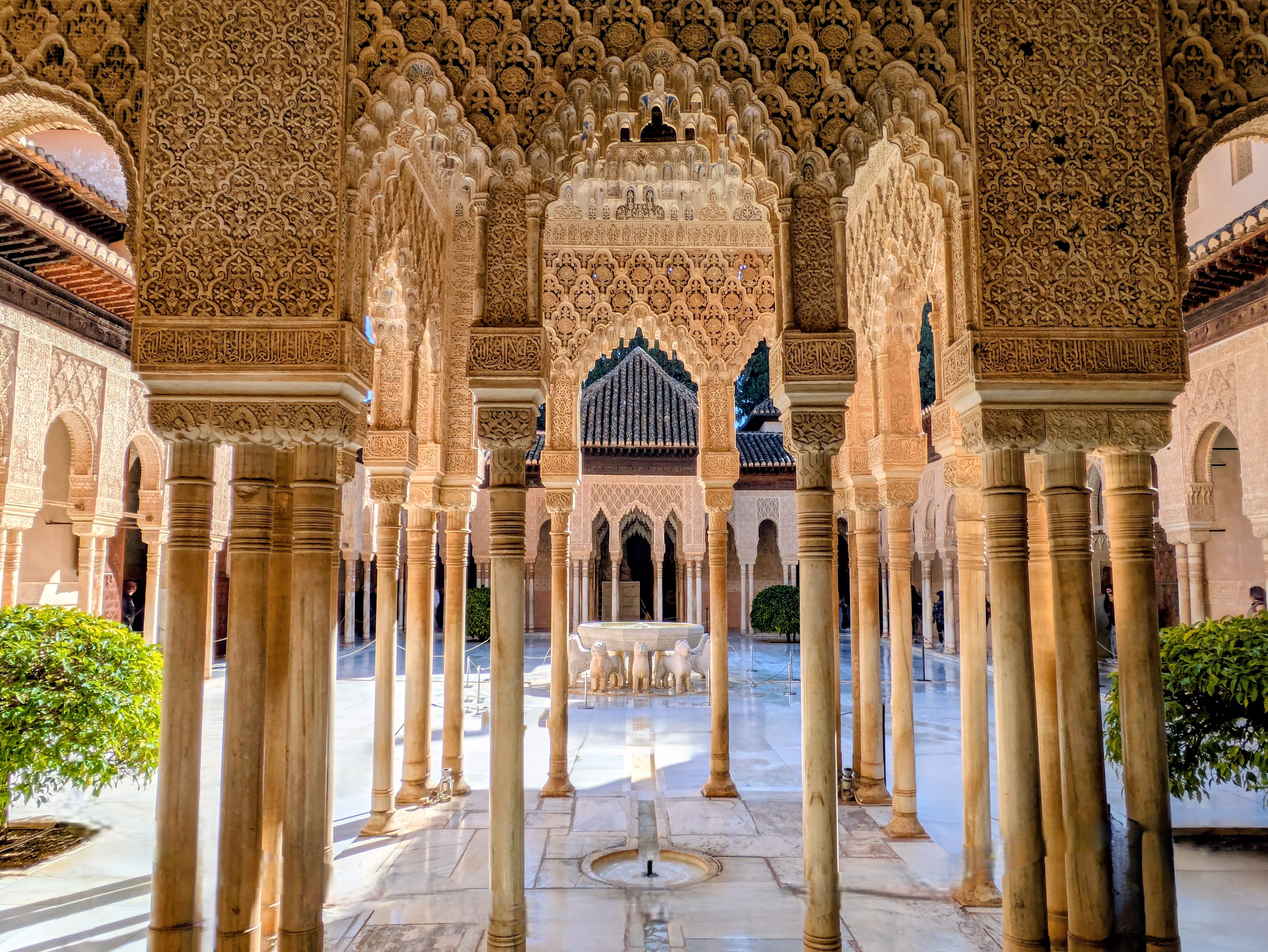
In the Patio de los Leones,
marble glows in the early sun.
The lions stand in their circle,
bearing the quiet dignity of things carved to outlast history.
Patio De Los Leones Pic
The Generalife gardens unfold in terraces of green and water.
Cypress shadows, narrow steps, the sound of fountains tucked into corners.
A softer world after the sharp ascent.
By late morning,
the palace releases you slowly back into Granada,
your legs still aware of the mountain you climbed to reach the day.
Some places you visit.
Others make you earn them.
The Alhambra was the latter.
Overnight: Cordoba
Day 7 · Granada → Córdoba
Where sunlight sharpens the edges of a city built on crossings.
Morning leaves Granada in clear light —
a sky rinsed clean after days of weather,
the Sierra Nevada still carrying thin ribbons of snow in its folds.
The drive north opens easily, the road unwinding through soft hills and olive groves.
Somewhere along the way you stop at the National Geographic **Mirador del Paseo photo point —
a simple overlook, nothing more,
yet the whole landscape widens from it.
A pause, a breath, a reminder
that even the roadside can feel like a scene.
Del Paseo Pic
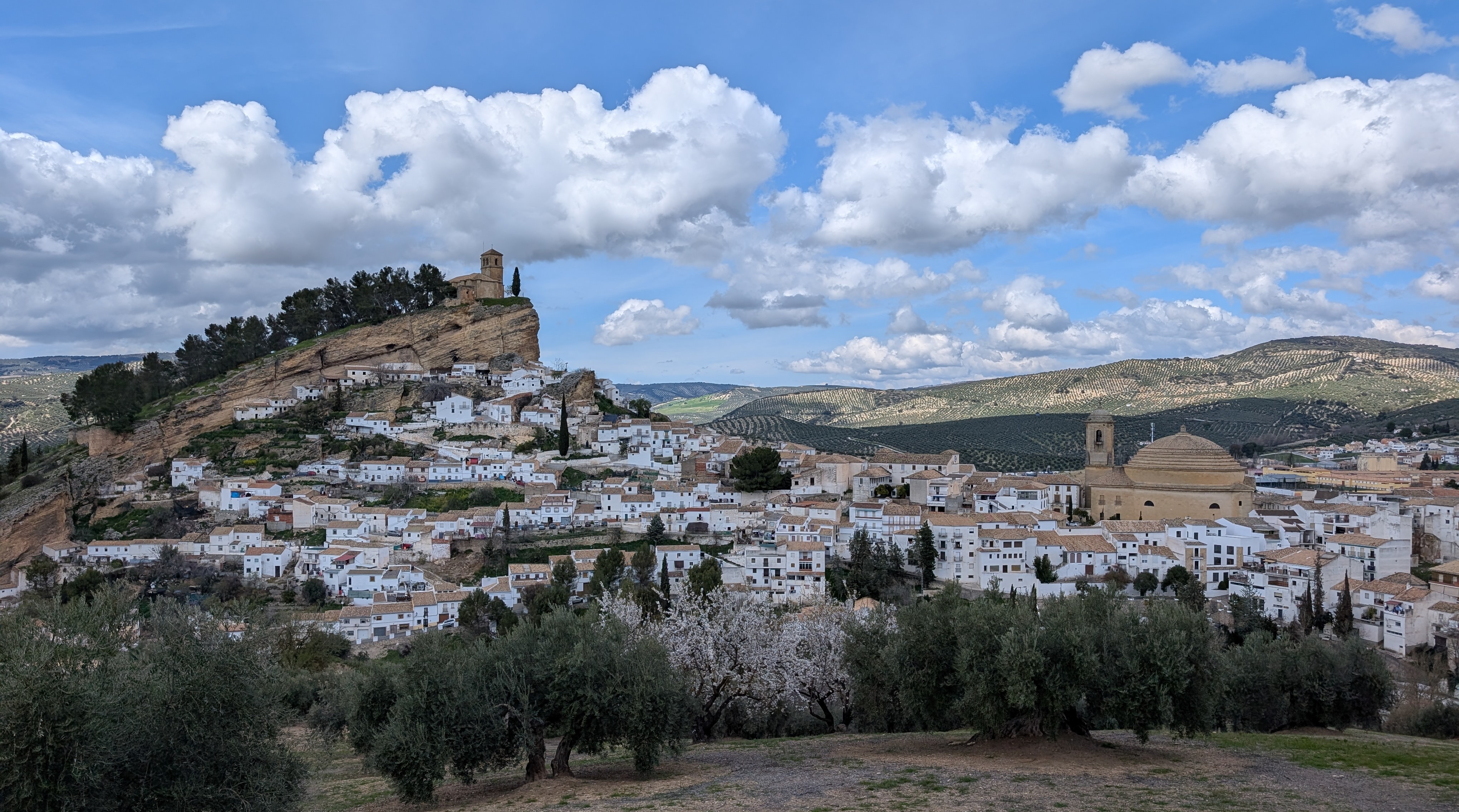
Córdoba arrives in sunlight, its streets warming quickly.
You begin in the Jewish Quarter,
a tangle of narrow lanes whitewashed and bright,
flower pots spilling color against the walls,
the air carrying a faint sweetness from the courtyards tucked just out of view.
There is an intimacy here —
a softened geography of thresholds and shadows.
As the day brightens, the city becomes a map of crossings.
Stone, water, culture, centuries —
everything converges at the Roman Bridge,
its arches stretching across the Guadalquivir with the quiet confidence of something that has endured every kingdom that passed through.
You walk its length slowly,
feeling the edge of the city shift beneath your feet:
ancient here, present there, future in the middle distance.
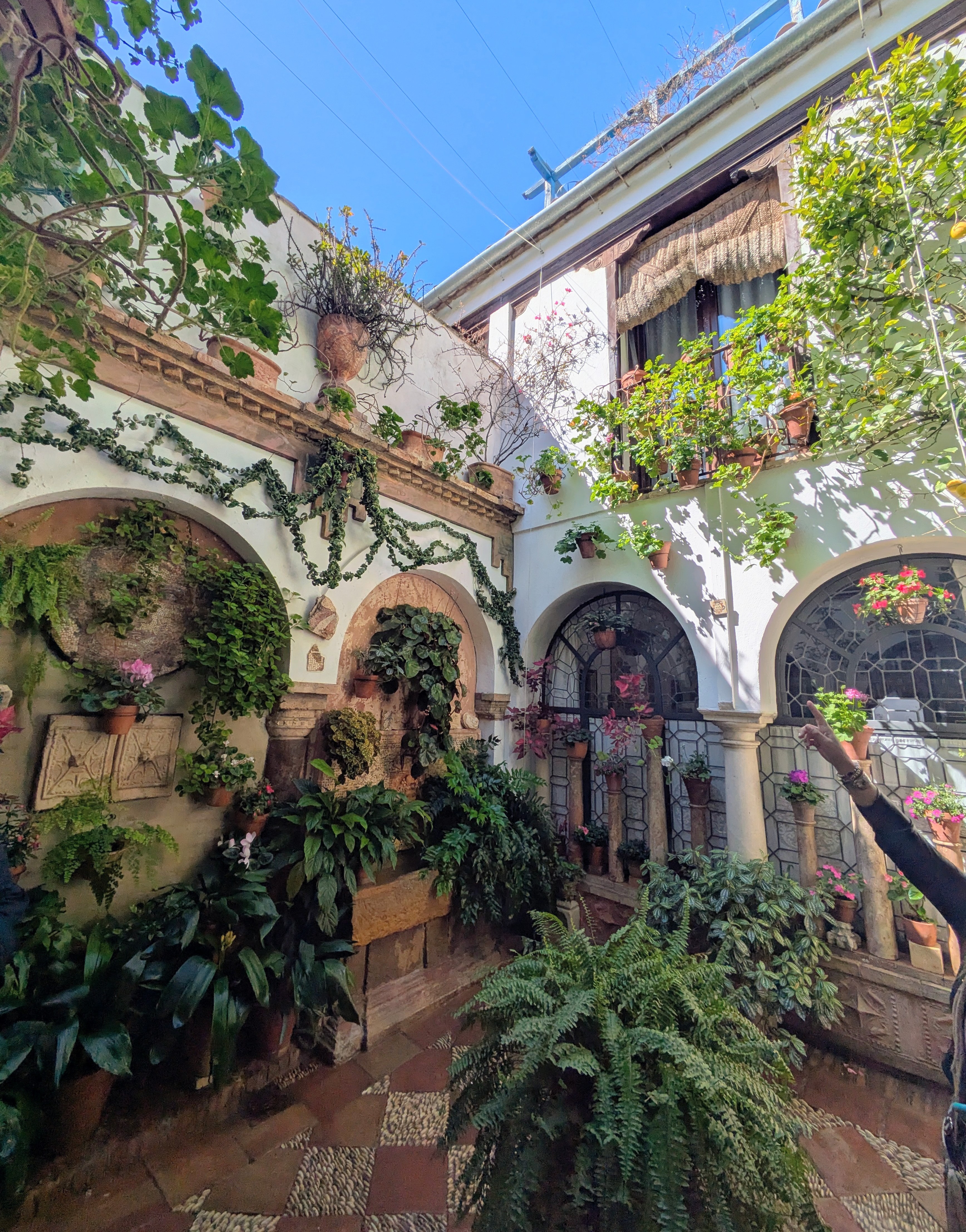
Patios open like small secrets —
cool mosaic floors, shaded plants,
glimpses of water or tile that feel like the city exhaling between walls.
Córdoba reveals itself in fragments,
as if offering its beauty one room at a time.
Patios Pic
By noon, the crowds gather.
Streets that were soft and quiet in the morning
grow thick with sound and movement.
It is the hour when Córdoba leans fully into the day,
sunlight pooling in the squares, voices rising against the stone.
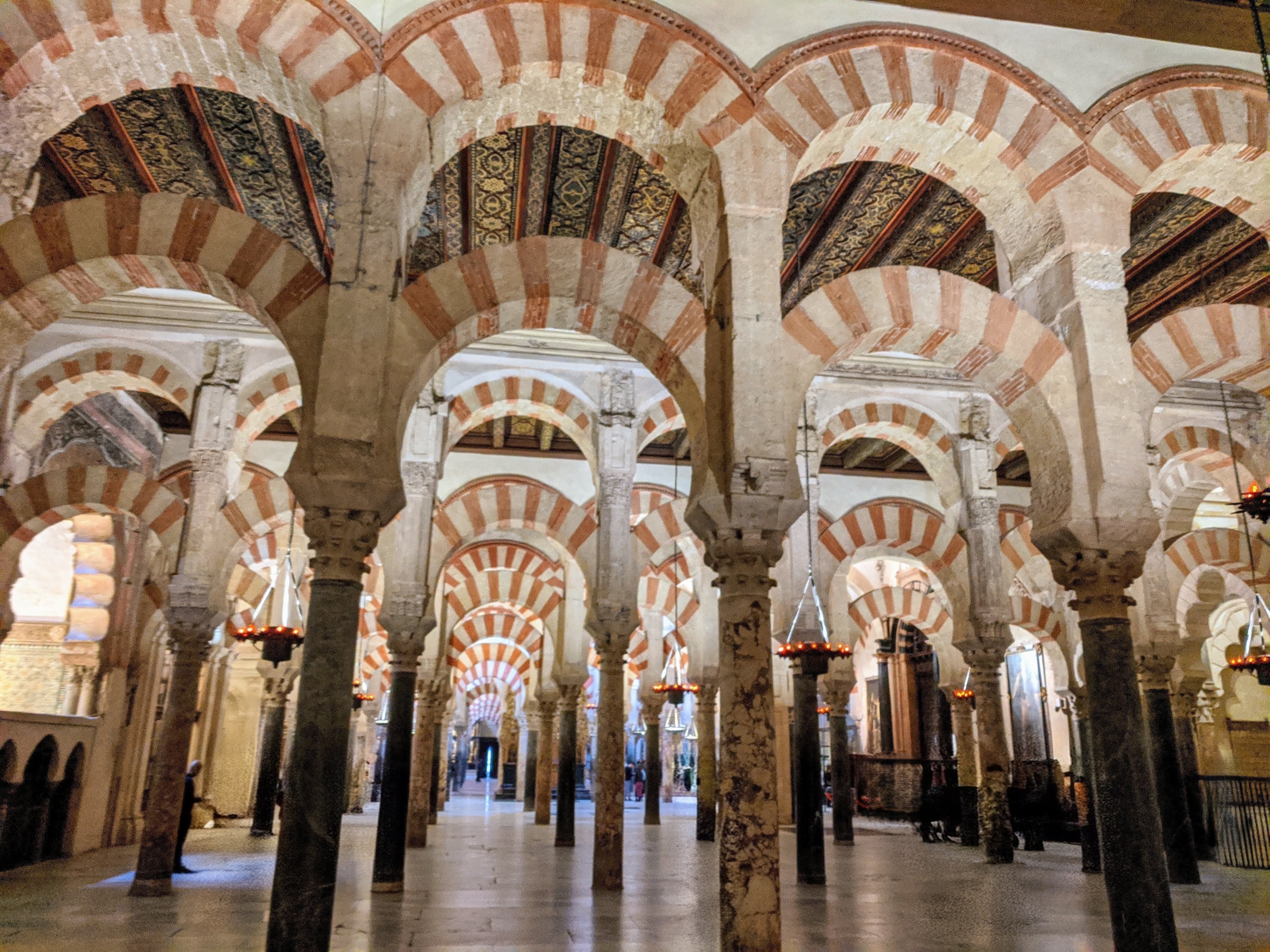
Though we visited the Mezquita in 2019 and didn’t step inside this time, its arches and alternating stripes remain part of how we remember Córdoba — a place where geometry became devotion.
Mezquita Pic
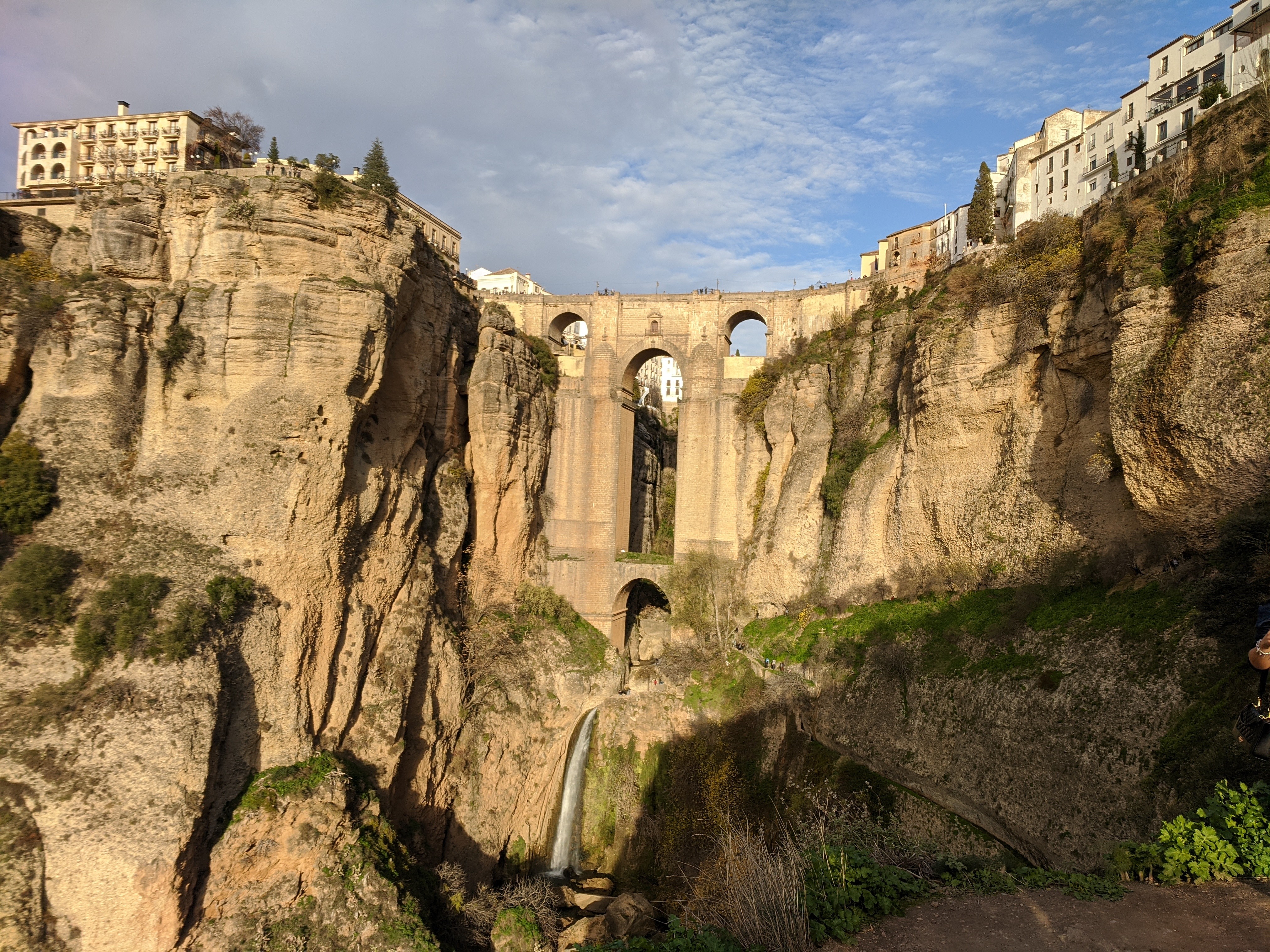
That same year we also traveled to Ronda,
a city split by a gorge so deep it feels like the earth remembering its own fracture.
Standing on the Puente Nuevo, with wind threading through the canyon below,
you learn something about Spain’s love of edges,
of building cities not just on land but on thresholds.
Ronda Pic
Those places still echo through this trip — memory shaping the way we walk the present.
Evening brings something entirely different —
a turning of the city toward rhythm and ritual.
At the Royal Stables,
you watch the equestrian show unfold:
horses moving with impossible precision,
flamenco rising in sharp, percussive bursts,
dance and horsemanship entwined,
muscle and music answering one another in the dim arena light.
A performance that feels carved out of tradition,
yet alive in the moment —
Spain distilled into motion.
Night settles slowly over Córdoba,
the stone cooling,
the bridge glowing in gentle illumination.
A city of crossings and edges,
held together by light and centuries.
Overnight: Córdoba
Day 8 · Córdoba → Aranjuez → La Finca
Where winter wind sharpens the day, and royal gardens hold their breath.
Morning leaves Córdoba under a sky of hard, bright blue —
beautiful, but deceptive.
The moment you step outside, the wind slices through the sunlight,
a blistering cold that turns every street into a corridor of winter.
The temperature feels carved from the same stone that built the city.
The drive north moves through open plains where the wind gathers speed,
pushing sideways against the car,
rattling the landscape into motion.
Olive groves sway in long silver waves,
a reminder that not all cold is stillness.
By late morning you reach Aranjuez,
and even here, where the Tagus should soften the air,
the cold lingers sharply.
The Royal Palace rises pale and elegant in the wind,
its long façade absorbing the morning chill.
You walk its edges with your shoulders tight against the gusts,
the kind of cold that makes you aware of every doorway and sunlit stone.
The Jardín del Príncipe stretches outward —
broad paths, sculptures, ponds —
but today the garden feels drawn inward,
its trees stripped into silhouettes by the season.
Wind shakes the branches;
fountains spray sideways;
the river moves in choppy, hurried ripples.
Jardin Pic
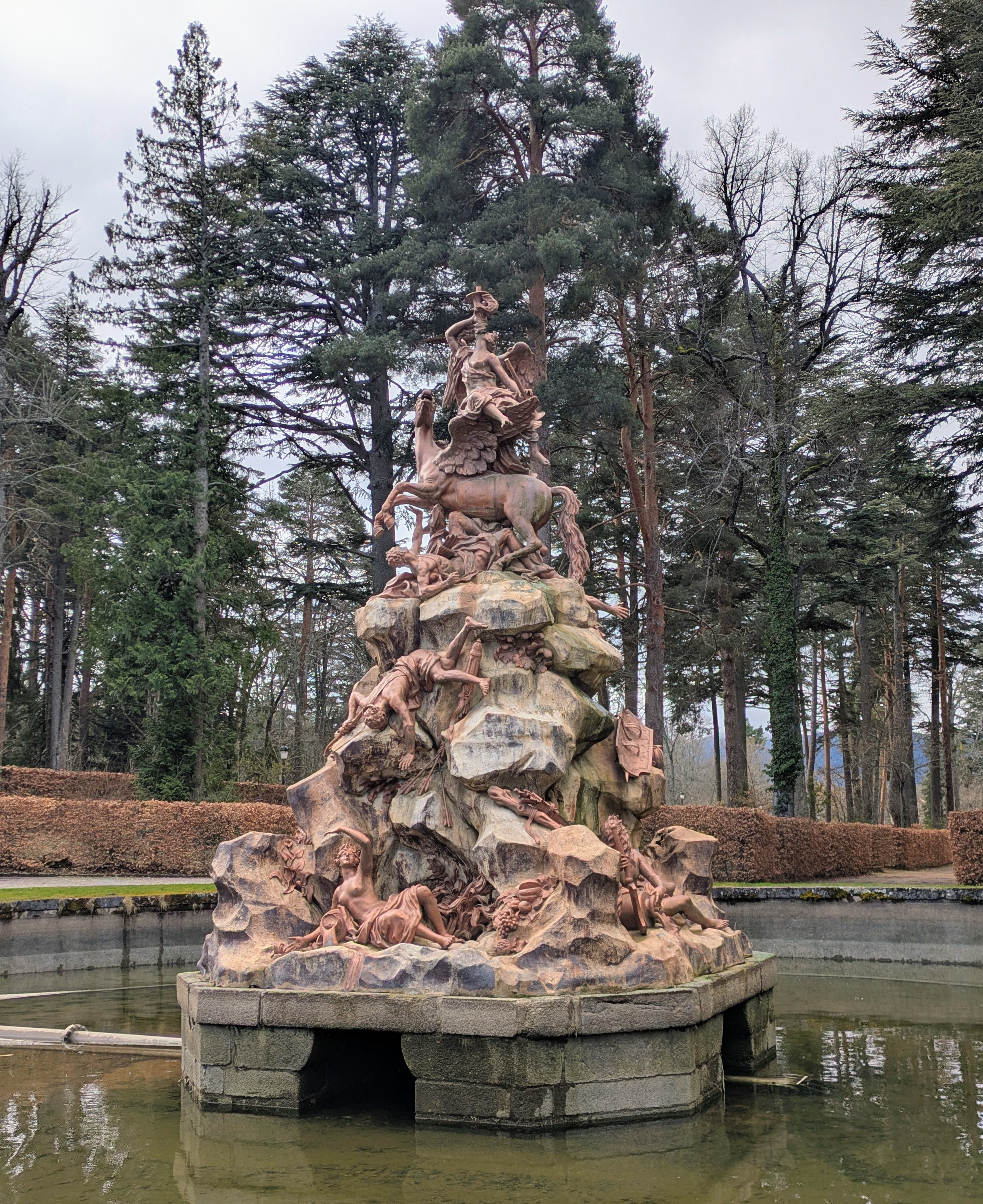
The Garden of the Island is quieter,
but even here the cold persists,
tucking itself into the shaded corners of bridges and hedges.
At the Mercado de Abastos,
the day briefly softens —
warm bread, bright stalls,
voices rising against the cold like little pockets of heat.
A welcome contrast before stepping back into the gusts.
The afternoon drive toward Madrid brings relief.
The wind begins to ease,
temperatures slowly warming as you leave the open plains
and slip into the more sheltered edges of the capital.
By the time you reach La Finca,
the day has shifted into something gentler —
still crisp, but no longer biting.
The hotel’s modern calm feels like a small refuge after a day carried by weather.
A day of movement shaped not by landscapes,
but by wind —
the kind that tests pace, posture, and patience
until the afternoon finally loosens its grip.
Overnight: La Finca (Madrid region)
Day 9 · La Granja → Segovia → El Escorial → La Finca
Where winter wind edges the day, and stone carries the memory of empires.
Morning breaks cold and sharp over La Finca —
a bright sky, but the kind of brightness that lies.
The wind has returned, cutting across the open plateau
and carrying winter’s last insistence in its wake.
The road north leads first to La Granja,
the royal site where fountains sleep for the season
and the palace stands in pale symmetry against the hills.
In the cold wind, the gardens feel almost architectural —
avenues of bare trees, long sightlines,
statues holding their poses against the weather.
The air is brisk enough to quicken your steps,
yet the place holds a quiet majesty,
as if waiting for spring to return and reveal its full intention.
From La Granja, the drive into Segovia brings a shift in light.
Overcast skies hang low,
but shafts of sun begin to slice through,
thin bright seams promising a warmer afternoon.
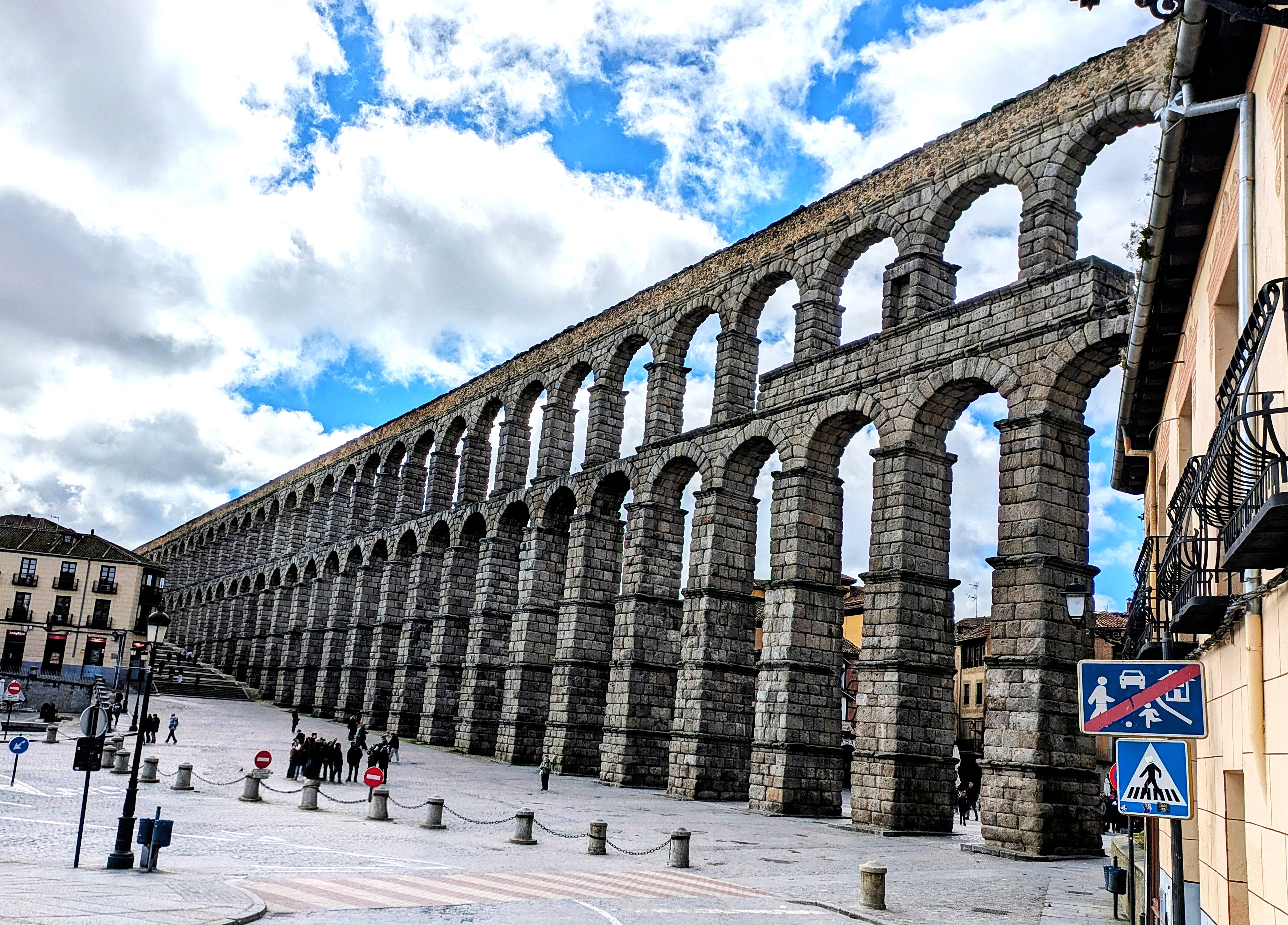
The Roman aqueduct rises from the stone like a solved equation —
precise, balanced, two thousand years of gravity perfectly negotiated.
You walk beneath its arches,
wind tugging at your jacket,
the cold deepening the shadowed spaces
and sharpening the moments when sunlight breaks through.
Roman Aquaduct Pic
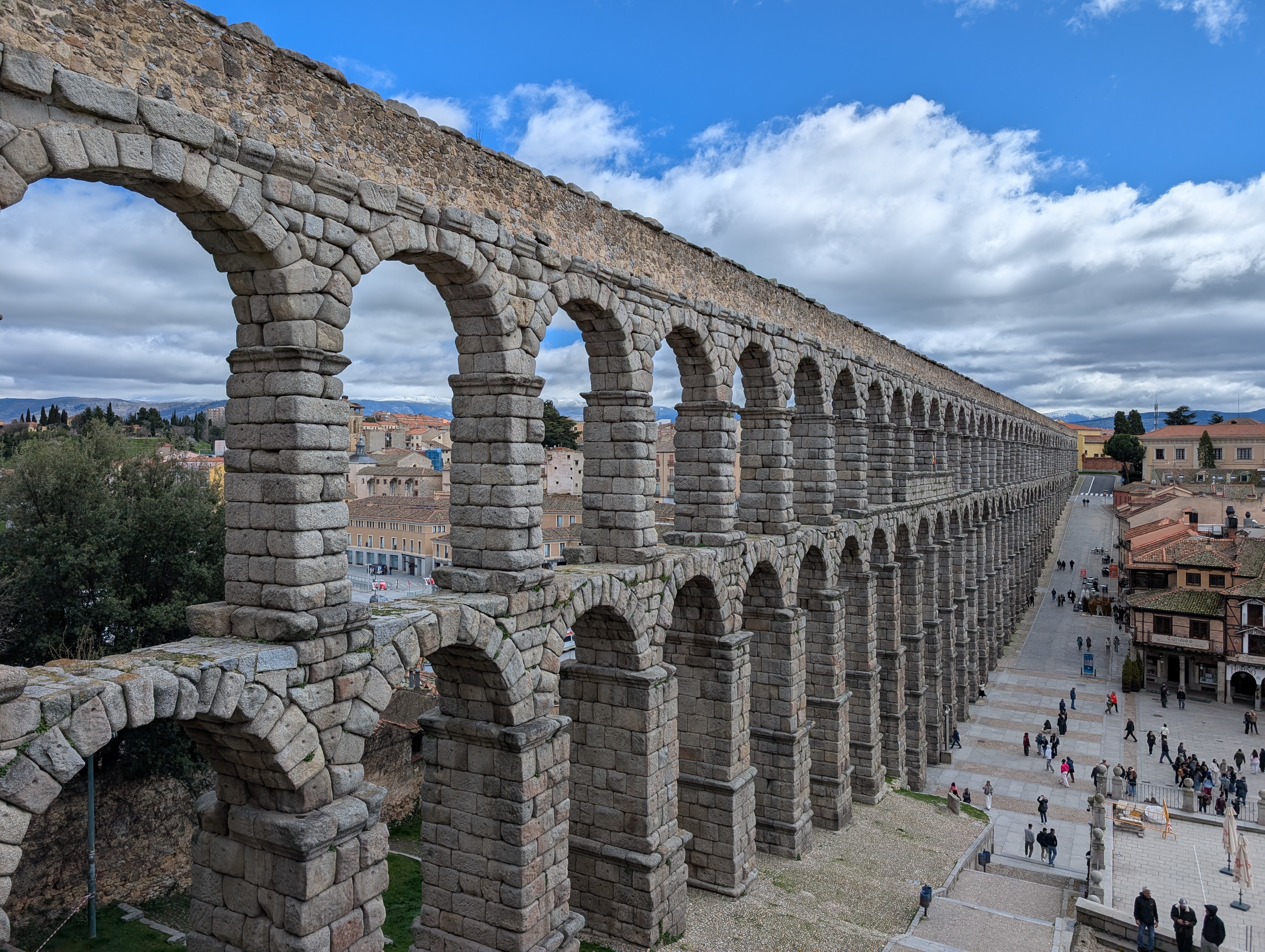
Segovia curls upward toward the cathedral,
its Gothic spires reaching into a sky that cannot decide
between grey and pale gold.
You wander the old streets,
the wind chasing along the corners,
turning the city into a patchwork of chill and possibility.
Then the Alcázar appears —
a fortress that seems almost airborne,
turrets rising in pointed defiance against the shifting sky.
Even in the cold, it feels like a story refusing to be forgotten,
stone brightening whenever sunlight touches it.
By afternoon the sky begins to clear,
soft warmth returning in brief intervals.
The road bends into the mountains,
and El Escorial comes into view —
vast, solemn, monastic in its gravity.
Granite walls stretch in disciplined symmetry,
the complex feeling part‑palace, part‑ledger of a kingdom’s soul.
Inside, the silence is deliberate,
a place built for contemplation rather than spectacle.
Outside, the Gardens of the Prince wait in winter stillness —
paths lined with patient trees,
fountains quiet beneath the season.
A short climb brings you to the Silla de Felipe II,
a stone seat overlooking the monastery
where sunlight finally breaks free,
casting long lines of gold across the valley.
Evening draws you back toward Madrid,
the wind easing at last,
the air softening as you descend.
Return to La Finca,
your day carried on stone and shadow,
on wind, architecture, and the steady promise of clearing light.
Overnight: La Finca (Madrid region)
Day 10 · La Finca → Alcalá de Henares → Madrid Airport
Where sunlight smooths the edges of the day, and a city of scholars offers its quiet.
The morning opens warm and windless —
a welcome contrast to yesterday’s cold gusts.
Sunlight settles across the Madrid outskirts in gentle, steady gold
as you drive east toward Alcalá de Henares,
a city shaped by learning, language, and long memory.
Alcalá greets you with calm streets and clear skies.
You begin at the University of Alcalá,
its courtyards drawn in perfect Renaissance geometry,
stone warmed by the morning sun.
The city feels intellectual in its very layout —
as if ideas had shaped its walls as much as hands did.
You wander along Calle Mayor,
one of the longest porticoed streets in Spain,
shaded by arches that catch the soft light just right.
Shops open slowly,
people move unhurried,
and the absence of wind lets the day breathe fully.
From there, you roam the old town’s quieter edges —
small plazas, tiled corners,
the kind of spaces that don’t announce themselves
but reward attention.
The weather lifts everything:
colors sharper, stone warmer,
the city carrying an ease that feels earned after days of cold.
You had planned to visit Complutum,
the Roman archaeological site on the edge of town,
but the gates are closed today —
a small, unexpected note in an otherwise open day.
Instead, you continue wandering,
letting the city offer what it wishes:
sun, quiet, and an unhurried sense of completion.
By late morning, you leave Alcalá and angle back toward Madrid, the sunlight steady, the air calm — a welcome contrast to the wind‑sharpened days before. In the morning of the next day, you slip into the city for one last wander.
You stroll through Parque del Centro, where Madrid relaxes into open lawns,
quiet footpaths, and pockets of shade that gather the warmth of early afternoon.
Families drift between benches, children trace circles around fountains,
and the city moves with a softer rhythm than its reputation suggests.
It’s the kind of park that feels like an exhale —
a place where the edges of the trip begin to loosen.
Parque Centro Pic
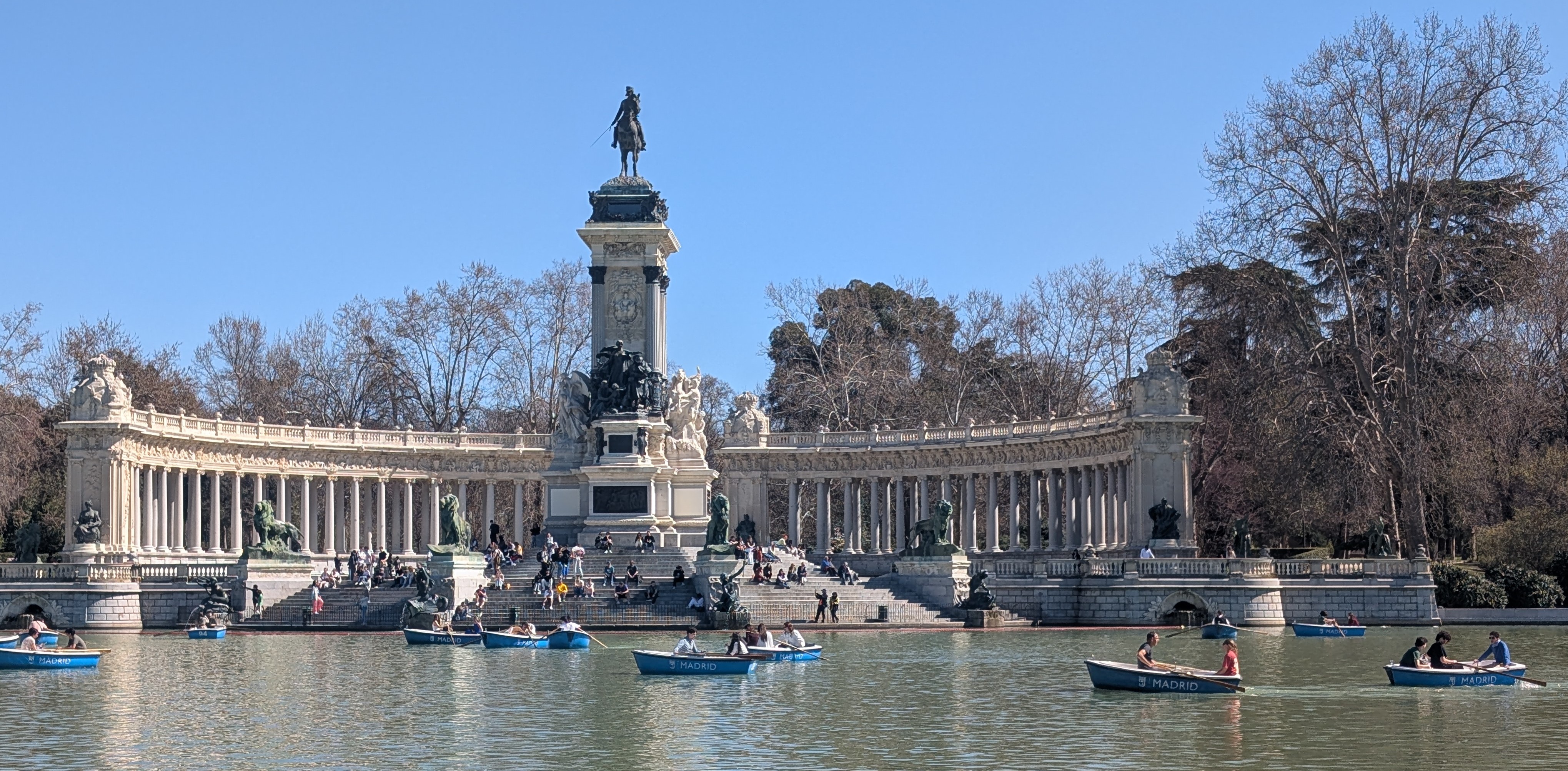
From there, the streets guide you toward Plaza Mayor,
its arcades glowing in the midday sun.
The square hums with a comfortable, unhurried energy —
musicians tuning, waiters calling orders,
tourists drifting past locals on lunch break.
You sit at an outdoor table and order a simple meal,
the kind that tastes better because the day has slowed.
Sunlight spills across the plaza, warming the stones beneath your feet,
a final reminder of Spain’s ability to gather you into a moment just by being itself.
Arch-Centro Pic
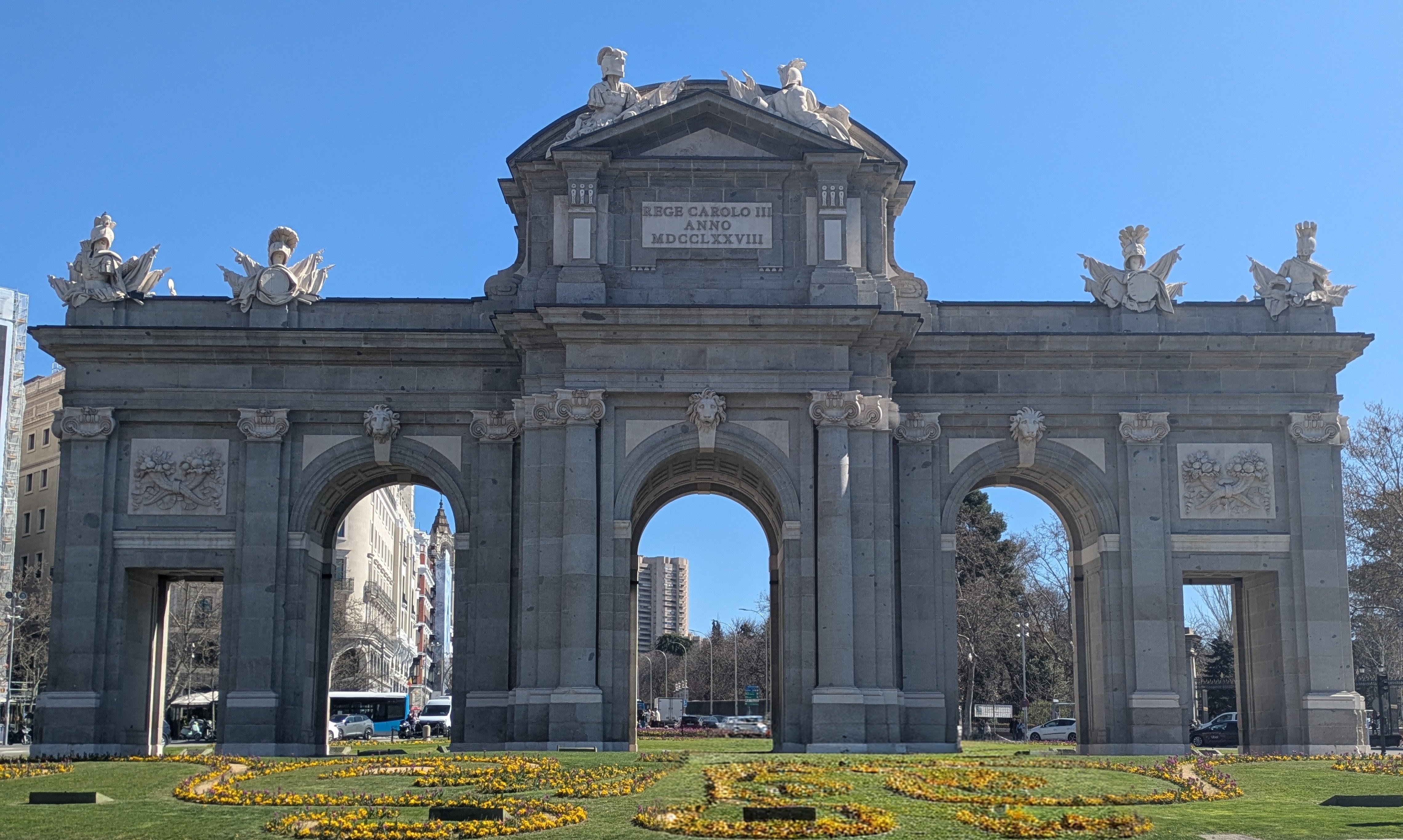
In the morning now, you return toward the airport perimeter,
the light slanting long across the highway.
A calm final morning in Spain,
the journey gathering itself into memory.
Return flight:
Spain Landscape Pic
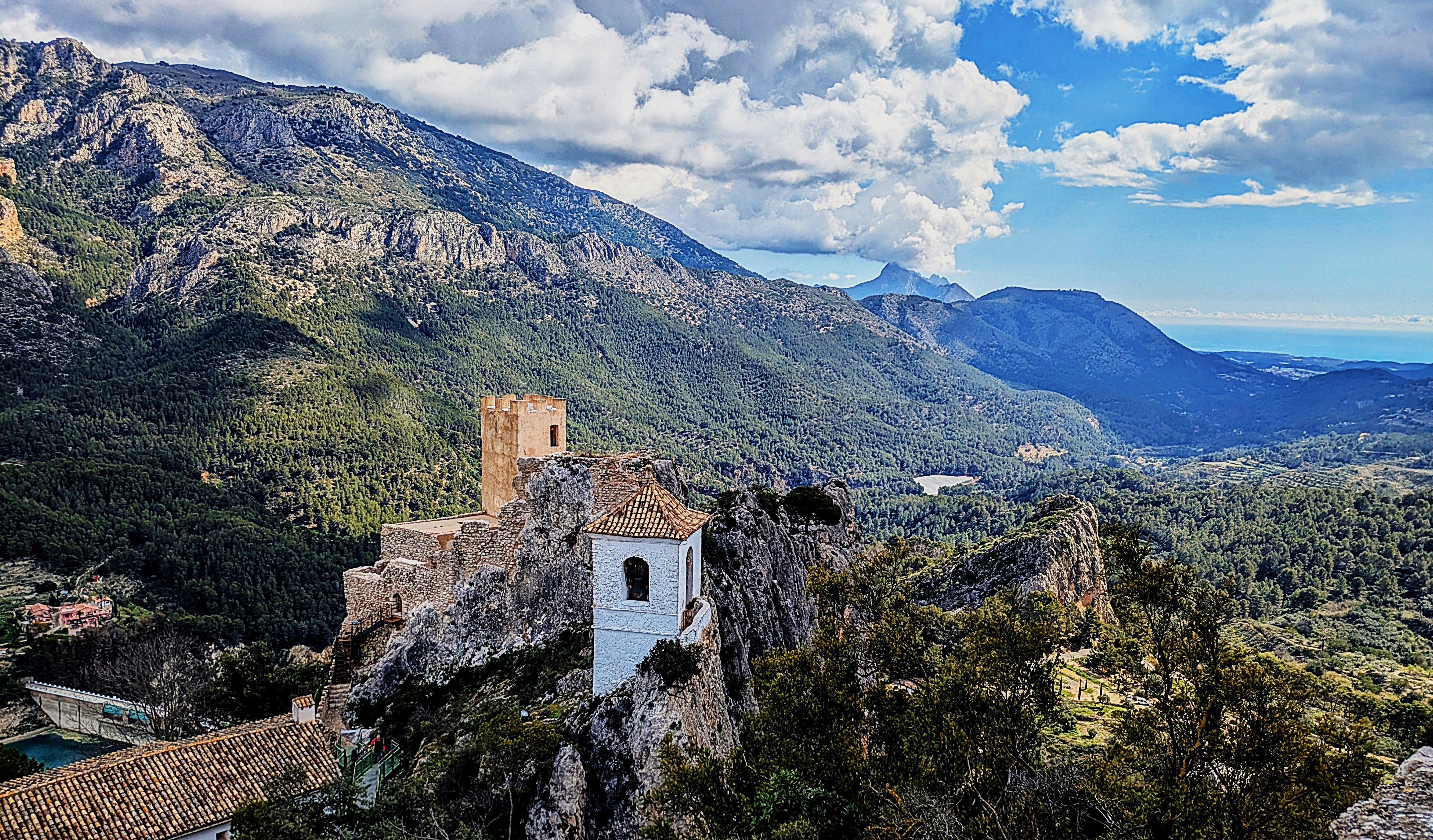
Afterthoughts
Spain wasn’t a trip of destinations so much as a movement through contrasts—
between stone and water, cliffs and valleys, cold edges and warm afternoons.
If Jordan asked you to slow down and Egypt asked you to surrender to the river,
Spain asked you to pay attention to thresholds:
the places where one world ends and another begins.
On movement.
Crossing Spain meant traveling across plateaus, ridgelines, coastlines, and old kingdoms.
The rhythm wasn’t fast or slow; it was attentive.
You learned to notice the difference between morning cold in La Mancha
and afternoon light along the Mediterranean,
the way a city like Granada gathers sunlight in its courtyards
versus the way Segovia holds shadow beneath its arches.
Distance mattered less than the edges between places.
On myth.
Spain’s myth-thread isn’t a single story like Isis and Osiris—
it’s a geography of borders:
Roman arches, Moorish foundations, Christian spires, Jewish quarters,
bridges crossing rivers that once divided worlds.
You felt it at Silla del Moro above the Alhambra,
at the Roman Bridge in Córdoba,
and even in the quiet of El Escorial—
a country defined not by unity, but by meeting points.
On contrasts.
Andalusia gives you warmth, white façades, orange trees,
while Castile greets you with stone, wind, and wide-open plains.
Valencia glimmers with Mediterranean brightness;
Granada holds a mountain edge;
Segovia rises in grey and gold.
Spain felt like stepping between climates, eras, and textures—
a country that never chose one identity when it could live in many.
On people.
Spain revealed itself in small human moments:
a sword-maker’s patience in Toledo,
the hum of a café as rain threatened in Valencia,
a stable master guiding horse and flamenco dancer in perfect rhythm,
the quiet kindness of locals in narrow streets
where the weather had chased most wanderers away.
Not grand gestures—just warmth, presence, and rhythm.
On place (what worked).
Walking cities rather than driving them shaped the trip.
Starting early softened the crowds;
giving each region its own day let the story deepen;
and returning to quieter hotels in the evenings
gave the movement space to breathe.
What held the route together wasn’t efficiency—
it was curiosity.
If we did it again.
- Add more time in Valencia’s old town when the weather warms.
- Revisit Segovia in full sun.
- Spend a slower morning in the gardens of La Granja.
- Let Granada’s hills shape another approach—perhaps without the hurry.
- Give Córdoba a quiet evening, when the city cools into itself.
Practical notes.
- Wind matters. Castilla’s cold carries farther than expected.
- Light matters. Spain looks different every hour; mornings and late afternoons are the country’s true lenses.
- Shoes matter. Hills, cobblestone, and unexpected climbs demand good footing.
- Time matters. The best hours are never on the itinerary—
they happen in the in‑between spaces.
Ethics & presence.
Walk with intention.
Greet people in their language when you can.
Support local cafés, bakeries, and artisans.
Move slowly through old quarters,
knowing generations shaped these streets long before you arrived.
What stayed.
Not a single highlight, but a sequence of textures:
cold wind pushing across the plateau,
sun breaking through Segovia’s clouds,
the shock of blue in Villajoyosa,
the hush of Turia Park in pending rain,
the climb toward the Alhambra in morning light,
and the steady sense that Spain is best understood
not in the monuments,
but in the edges where its stories overlap.
This wasn’t a trip about covering Spain.
It was a trip about understanding how Spain reveals itself—
one threshold at a time.
Field photographs from this journey:
View the photo archive
More Field Notes
See other movements across landscapes: